The single most consequential decision on a student flute is closed hole versus open hole, and it is usually made backwards. Open hole flutes have perforated keys that require exact finger placement to seal, and if a young player’s fingers cannot cover them, notes simply do not sound. Closed hole — often called plateau — keys forgive imperfect placement and let a beginner concentrate on embouchure and breath, which is where the real difficulty lies in the first year. Most students should start closed hole and move to open hole later if their playing demands it.
The second thing worth knowing is that the headjoint does most of the work. It is where the air stream is split and where the tone is actually formed, which is why quality flutes advertise hand-cut headjoints and silver lip plates while the body specification matters far less. A student instrument with a well-cut headjoint responds more easily and rewards good breath support. This guide compares closed and open hole student flutes for school bands, beginners and players ready to step up.
Our top picks


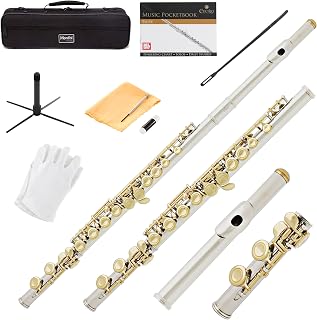
As an Amazon Associate we earn from qualifying purchases at no extra cost to you.
Quick Comparison
| Product | Best For | Standout Feature | Watch Out For |
|---|---|---|---|
| Di Zhao DZ-401 BOF | Advancing students | Hand-cut headjoint with sterling silver lip plate | Open holes demand precise finger placement |
| EASTROCK Open Hole Flute | Students moving to open hole | Silver-plated body with a full accessory kit | Open holes frustrate small hands |
| YANASON Closed Hole C Flute | Young beginners | Forgiving plateau keys with a complete kit | Nickel plating tarnishes without cleaning |
| EastRock Closed Hole (Red) | Children choosing their own instrument | Coloured finish with case, stand and kit | Coloured plating shows wear at contact points |
| Glory Closed Hole C Flute | Lowest-cost school band entry | Nickel silver body with care accessories | Pad quality varies; check for leaks |
| Eastar EFL-1S | Balanced beginner package | Silver-finish full kit with sixteen keys | Stock headjoint limits advanced tone work |
How to Choose
- Closed hole for beginners: Plateau keys seal regardless of exact finger placement, which lets a new player focus on embouchure and air rather than hand position.
- The headjoint makes the tone: A well-cut lip plate and riser determine how easily the instrument speaks. It matters far more than the body material at student level.
- Offset G is easier: An offset G key sits closer to the natural resting position of the left ring finger and reduces strain, particularly for smaller hands.
- C foot versus B foot: A C foot is shorter and lighter and covers all standard student repertoire. A B foot adds one low note and a little weight.
- Check the pads and springs: Sticky pads and weak springs cause notes to fail unpredictably. Test the full range and listen for keys that do not close crisply.
Top Picks Reviewed
Best Step-Up Instrument: Di Zhao DZ-401 BOF
The hand-cut headjoint with a sterling silver lip plate and riser is what separates this from generic student flutes — the instrument responds to subtle changes in air speed and direction, which is exactly what an advancing student needs to develop tone colour. Open holes, an offset G and a B foot make it a proper conservatoire-track instrument.
Open holes are unforgiving. A student who has only played plateau keys will spend a few weeks fighting notes that will not sound until their fingers learn to seal properly.
Best Open Hole Value: EASTROCK Open Hole Flute
Sixteen keys with open holes on a silver-plated body, supplied with a case, stand, gloves, tuning rod and cleaning kit. For a student whose teacher has asked them to move to open hole, this is an affordable route.
Small hands struggle with perforated keys. Temporary plugs are the standard solution and let a player transition gradually rather than all at once.
Best for Young Beginners: YANASON Closed Hole C Flute
Sixteen closed-hole keys mean every note sounds as long as the key is pressed, which removes the most demoralising early obstacle. The nickel-plated body is durable and the kit includes everything from a stand to a tuning rod.
Nickel plating tarnishes if the instrument is put away wet. Swabbing after every session takes thirty seconds and prevents it.
Best for Reluctant Starters: EastRock Closed Hole in Red
Letting a child choose an instrument they find appealing is not frivolous — it affects whether they practise. This closed-hole flute comes in a coloured finish with a case, stand and cleaning kit.
Coloured plating wears at the contact points where fingers and the chin rest sit. Cosmetic only, but it will not stay showroom fresh.
Lowest-Cost Entry: Glory Closed Hole C Flute
A nickel silver closed-hole flute with case, tuning rod, joint grease, cloth and gloves at minimal outlay, aimed at parents finding out whether a child will stay with school band.
Pad quality is the variable. Test every note before the return window closes, and be prepared for a technician to seat a pad or two.
Best Balanced Kit: Eastar EFL-1S
A silver-finish sixteen-key closed-hole flute in a complete kit, sitting between the cheapest options and genuinely intermediate instruments. Key action is even and the body is well finished.
The stock headjoint is the ceiling. A student who progresses quickly will want a better-cut headjoint before they need a whole new flute.
Frequently Asked Questions
Should a beginner start on open or closed hole?
Closed hole. Plateau keys seal regardless of finger placement, so the student can concentrate on embouchure and breath control, which are the genuinely difficult parts of early flute playing.
What is an offset G?
The G key is positioned slightly forward to match the natural reach of the left ring finger. It reduces hand strain and is generally recommended for students, especially those with smaller hands.
Why can I not get a sound out of the flute?
Embouchure and air angle. The air stream needs to split across the far edge of the embouchure hole with roughly a third of the hole covered by the lower lip. It takes most beginners a few sessions.
How do I look after a student flute?
Swab the inside dry after every session, wipe fingerprints off the plating, and avoid over-greasing the joints. Have the pads checked annually, since sticky or leaking pads cause most playing problems.
Final Thoughts
Start closed hole with an offset G, prioritise a well-cut headjoint over cosmetic features, and check every note in the range before committing. A student flute that seals properly and responds easily lets a beginner build embouchure and breath support, which is the foundation everything else on this instrument is built on.