A capo looks like the least interesting object in a guitar case and quietly causes more tuning problems than anything else in it. Clamp too hard and every string goes sharp, because you have effectively bent them behind the fret. Clamp too softly and the third string buzzes. Sit it a few millimetres too far back from the fret and you get both problems at once. Most players who complain that their capo makes the guitar sound bad are describing a pressure and placement issue, not a defective product.
That is why the design differences matter more than the price. Spring-loaded trigger capos are one-handed and fast, which is what you want mid-set, but they apply a fixed pressure regardless of your neck. Screw-adjustable models let you dial in exactly enough tension to fret cleanly and no more, which is kinder to intonation but slower to move. Fingerboard radius and neck thickness change which type suits your guitar. Here is how the practical options compare for stage use, recording and everyday practice.
Our top picks




As an Amazon Associate we earn from qualifying purchases at no extra cost to you.
Quick Comparison
| Product | Best For | Standout Feature | Watch Out For |
|---|---|---|---|
| Shubb C1 | Best intonation control | Adjustable screw sets exact clamping pressure | Two-handed to reposition mid-song |
| WINGO Rosewood Capo | Budget everyday use | Light spring clamp with picks included | Fixed tension can pull chords sharp |
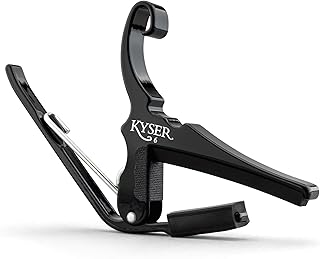
| Kyser Quick-Change | Fast changes on stage | Single-handed trigger action with a strong spring | Firm spring can sharpen thin-necked guitars |
| D’Addario NS Tri-Action | Balance of speed and control | Trigger action with micrometer tension adjustment | Costs more than a plain spring capo |
| Universal Clip Capo | Guitar and ukulele sharing | Slim profile that fits smaller necks | Less consistent across wider fretboards |
| Sondery Adjustable Capo | Players who also restring often | Built-in bridge pin puller in the handle | Bulkier than a simple trigger design |
How to Choose
- Trigger versus screw: Trigger capos move in a second and apply whatever pressure the spring dictates. Screw-adjustable models take longer but let you use the minimum tension that frets cleanly, which protects intonation.
- Match the fretboard radius: Acoustic and electric necks curve differently. A capo with a flat pad on a curved board presses the outer strings harder than the middle ones, causing uneven tuning.
- Placement matters as much as the capo: Sit it just behind the fret, not on top of it and not halfway down the space. Correct placement fixes most buzzing without any extra pressure.
- Neck thickness: Thick acoustic necks and slim electric necks need different clamping range. A capo that grips a Stratocaster perfectly may be at full stretch on a dreadnought.
- Storage while playing: Trigger capos clamp onto the headstock when not in use. Screw capos usually do too, but check, because a capo left on a music stand gets lost.
Top Picks Reviewed
Best for Tuning Accuracy: Shubb C1
The Shubb design uses a roller and an adjustable screw so you set the closing pressure once for your guitar and then simply flip the lever. Because you can dial the tension down to just enough, it is the option least likely to pull your chords sharp, which is why studio players keep reaching for it.
Repositioning takes two hands and a moment of attention. Between songs that is nothing; mid-song it is not viable.
Best Budget Option: WINGO Rosewood-Finish Capo
A light, unobtrusive spring capo that does the job on both acoustic and electric necks, supplied with a handful of picks. For a beginner who has just discovered that half their songbook needs one, this removes the barrier immediately.
Fixed spring tension is the compromise. On a lightly strung acoustic it can push the second and third strings noticeably sharp, so check tuning after clamping.
Fastest to Use: Kyser Quick-Change
Squeeze, slide, release — the Kyser is designed to be moved with your fretting hand alone while the song keeps going. That is genuinely useful in a set where three consecutive songs sit at different frets, and the aluminium construction survives years of abuse.
The spring is strong. On slim-necked electrics and light-gauge strings it applies more pressure than needed, and you will want to retune or nudge the placement.
Best Compromise: D’Addario NS Tri-Action
This one tries to have both, and largely succeeds: single-handed trigger operation with a micrometer screw that limits how far the jaws close. You get Kyser speed with Shubb-style pressure control, plus a built-in pick holder.
It costs meaningfully more than a plain spring capo. If you only ever use one fret position, that flexibility is money you did not need to spend.
Best Slim Profile: Universal Clip Capo
The narrow body suits smaller necks, which makes it a sensible shared capo for a household that owns both a guitar and a ukulele. Clamping is quick and the low profile keeps it out of the way of your fretting hand.
Across a wide acoustic fretboard the pressure distribution is less even than a purpose-built acoustic capo, so buzzing on the outer strings is more likely.
Most Practical Extras: Sondery Adjustable Capo
Adjustable tension for clean fretting at any position, plus a bridge pin puller built into the handle. If you restring your own acoustic, having that tool permanently attached to something you never leave home without is quietly clever.
The added function makes it bulkier than a minimal trigger capo, and it sits less neatly on the headstock when parked.
Frequently Asked Questions
Why does my guitar go sharp when I use a capo?
Too much clamping pressure stretches the strings behind the fret, raising their pitch. Use the least tension that produces a clean note, place the capo just behind the fret, and retune after clamping if you are recording.
Where exactly should the capo sit?
Immediately behind the fret wire, in the same place your finger would press. Sitting it in the middle of the fret space requires far more pressure and causes both buzzing and sharpness.
Can I use the same capo on electric and acoustic?
Usually yes, though the fretboard radius and neck depth differ. Adjustable models cope with both far better than fixed-tension springs, which are typically optimised for one or the other.
Does a capo damage the neck or strings?
Not with a padded capo used sensibly. Leaving a heavily sprung capo clamped permanently can mark a soft finish over time, so take it off the neck when you put the guitar away.
Final Thoughts
If you play live and change keys often, a fast trigger capo is worth the small intonation compromise. If you record, or your guitar is sensitive to pressure, take the adjustable screw design and set it properly once. Either way, correct placement behind the fret solves more problems than upgrading the capo ever will.