
Best blender protein shakes hinge on one thing more than raw horsepower: whether the jar creates a vortex strong enough to pull dry powder down into the liquid instead of leaving it stuck to the sides. This guide compares seven machines on motor power, jar design, blade geometry and cleanup.
As an Amazon Associate we earn from qualifying purchases.
By Daniel Foster
🛒 Best Price Today on Amazon
Prime members get fast, free shipping on everything above, plus member-only deals. New members get a 30-day free trial — cancel anytime.
What Actually Determines a Smooth Shake
The best blender protein shakes demand solves a fluid dynamics problem, not a power problem. A 1,500 W motor in a badly shaped jar leaves clumps, while a 900 W personal blender with a narrow cup mixes cleanly, which is why the specifications below are ordered the way they are.
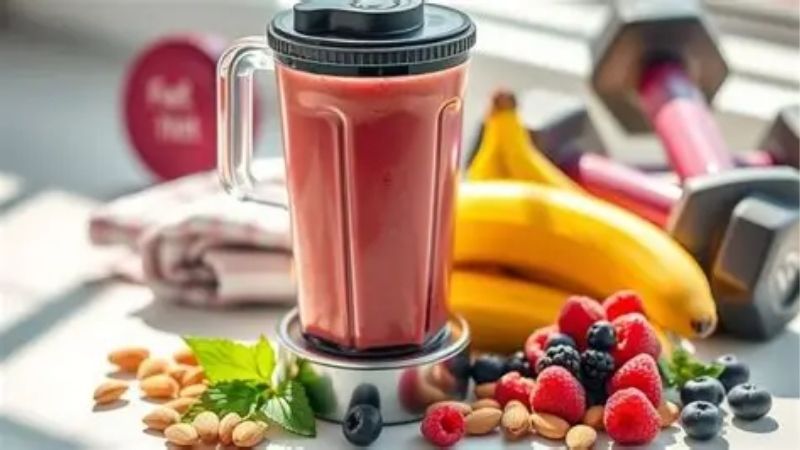
Motor Power, Jar Volume and Blade Design: The Deciding Numbers
Three figures matter when picking the best blender protein shakes call for: motor wattage, jar or cup capacity in ounces, and blade configuration. Personal blenders typically run 700 to 1,200 W with 24 to 32 oz (710 to 950 mL) cups, while full-size jars hold 48 to 64 oz (1.4 to 1.9 L).
Watts describe input, not blending ability. A tall, narrow vessel keeps ingredients near the blade and produces a tighter vortex, which is why single-serve cups often outperform large jars on a small volume of liquid.
Blade geometry finishes the job. Angled multi-level blades cut across several planes and prevent powder from riding above the liquid line, while a flat two-blade design in a wide jar leaves a dry ring near the top.
Space and Fit: Counter Height and Jar Clearance
Full-size blenders stand 15 to 20 in (38 to 51 cm) tall with the jar seated, and standard wall cabinets sit around 18 in (46 cm) above the counter. Measure that gap first, since many machines will not fit under a cabinet assembled.
Personal blenders solve that problem at 12 to 15 in (30 to 38 cm) tall, but the cups add storage clutter. Also check whether the cup fits your car cup holder or gym bag if you intend to blend and go.
Mixing Powder Without Lumps
Order of loading changes the result more than any setting on the best blender protein shakes machines. Liquid first, powder second and frozen items last gives the blade something to grip and prevents dry clumps from packing against the base.
Start on low for a few seconds before ramping up. Machines with a soft-start or a low speed setting handle powder better than single-speed units that jump straight to full throttle and blow powder against the lid.
Cleaning, Odor and Long-Term Upkeep
Dairy and plant proteins both stain and smell if left in any best blender protein shakes vessel, so rinse immediately and run a soap-and-water cycle before the residue dries. Most jars are top-rack dishwasher safe, but blade assemblies often are not.
Gaskets absorb odor over time. Removing and washing the seal weekly, then drying it fully, prevents the stale smell that eventually makes people replace an otherwise working blender.
Best Blender Protein Shakes Picks: Seven Models Compared
The lineup spans personal blenders, mid-range countertop machines and one premium option. Specifications are manufacturer-stated and paired with recurring themes in long-term owner reports.
NutriBullet Pro 900
A 900 W personal blender with 32 oz (950 mL) cups and an extractor blade profile designed for a tight vortex, making it one of the most reliable options for dissolving powder cleanly.
Operation is press-and-hold with no speed control, and running it for long periods can trigger thermal cutoff. For 30-second shakes that is rarely an issue.
Ninja Fit QB3001SS
A compact 700 W personal blender with two 16 oz (473 mL) to-go cups, pulse control and a footprint small enough for a dorm or office kitchen.
Power is modest, so hard frozen fruit needs cutting first. It is one of the cheapest routes to a genuinely smooth shake with liquid and powder.
Beast Blender
A 1,000 W personal blender with a ribbed vessel wall that increases turbulence, a 34 oz option and a design intended to sit on the counter without looking like an appliance.
It costs considerably more than functionally similar bullet blenders, and the vessels are proprietary. Blending consistency on powders and greens is genuinely strong.
Vitamix Explorian E310
A full-size machine with a 48 oz (1.4 L) jar, variable speed and a hardened blade assembly built to run daily for years, with a warranty measured in multiple years rather than months.
It is expensive and loud, and the wide jar needs enough volume to form a vortex, so single small shakes can leave residue high on the walls. Use the tamper or blend a larger batch.
Blendtec Classic 575
A 1,560 W machine with a blunt safety blade, preset cycles and a jar wide enough to clean easily by hand, aimed at households blending multiple drinks a day.
The blunt blade relies on speed rather than sharpness, so short pulses do less than on a conventional blade. Run a full cycle for the best texture.
Ninja Professional BL610
A 1,000 W countertop blender with a 72 oz (2.1 L) jar and stacked blade assembly, the standard value pick for households blending large batches rather than single servings.
The tall jar will not fit under most wall cabinets assembled, and the blade stack is awkward to wash by hand. Batch performance for the price is hard to match.
Hamilton Beach Wave Crusher
A 700 W blender with a 40 oz (1.2 L) jar and a wave-shaped jar profile that improves circulation at lower power, plus a pour spout that reduces mess.
Motor power limits it with thick frozen mixtures, and build materials are basic. As an entry-level countertop machine for shakes with liquid, it does the job.
| Model | Power | Vessel | Type | Main trade-off |
|---|---|---|---|---|
| NutriBullet Pro 900 | 900 W | 32 oz / 950 mL cup | Personal | No speed control |
| Ninja Fit QB3001SS | 700 W | 16 oz / 473 mL cups | Personal | Modest power |
| Beast Blender | 1,000 W | Ribbed vessel | Personal | Price, proprietary cups |
| Vitamix Explorian E310 | Variable speed | 48 oz / 1.4 L jar | Full size | Loud, needs volume |
| Blendtec Classic 575 | 1,560 W | Wide jar | Full size | Blunt blade needs full cycle |
| Ninja Professional BL610 | 1,000 W | 72 oz / 2.1 L jar | Full size | Too tall for cabinets |
| Hamilton Beach Wave Crusher | 700 W | 40 oz / 1.2 L jar | Full size | Limited with frozen |
Amazon pricing moves frequently in this category, so check current listings and which cups or accessories are included before ordering.
Technique, Durability and Buying Timing
Getting the best blender protein shakes routine right involves habits as much as hardware, and the machines themselves fail in a small number of predictable ways.
Loading Order and Liquid Ratio
Liquid first is the single most useful habit. Roughly 8 to 12 oz (235 to 355 mL) of liquid per scoop of powder gives the blade enough fluid to form a vortex; thicker mixtures need a tamper or a pause to scrape down.
Ice and frozen fruit go in last, on top of the powder rather than under it. Loading frozen items first packs them against the blade, which is where stalling and the resulting motor heat usually begin.
Blending in two stages helps with frozen ingredients: pulse the frozen items into smaller pieces first, then add powder and run continuously. That avoids the stalling that overheats small motors.
What Wears Out
Blade bearings, drive couplings and gaskets are the three wear items across every brand. Plastic couplings on budget machines strip when the blender is repeatedly loaded too thick, which is the most common cause of sudden failure.
Motors rarely burn out on their own. When they do, the cause is usually repeated stalling under a mixture with too little liquid, so the habit that protects the coupling protects the motor at the same time.
Jars also cloud and craze over time, especially if washed at high dishwasher temperatures. Check that replacement jars, cups and gaskets are available for the model, since a cracked jar otherwise ends the machine.
Seasonal Demand and Deals
Blenders sell heavily in January alongside new fitness routines and again during fourth-quarter gift season. Amazon runs Prime Big Deal Days in early October, with Black Friday and Cyber Monday in late November as the deeper window for kitchen electrics.
Bundle contents vary more than price in this category: the same blender may ship with one cup or three. Compare what is in the box rather than the headline figure, since discounts differ by model and cannot be predicted.
Frequently Asked Questions
Common questions about blending powder-based drinks.
Why does my shake still have lumps?
Usually loading order or too little liquid rather than the machine. Add liquid first, start on a low speed, and give the machine a few seconds before ramping up so the powder is pulled under rather than blown to the walls.
Do I need a high-powered blender?
Not for liquid and powder alone. High power matters for frozen fruit, ice and fibrous greens; a 700 to 1,000 W personal blender handles straightforward shakes well.
Is a shaker bottle good enough?
For powder and water, often yes. A blender becomes worthwhile once you add frozen fruit, nut butters or greens that a shaker cannot break down.
How much protein should I be using?
That is a nutrition question rather than an appliance one, and the right amount varies by person. A registered dietitian or your physician is the appropriate source for that guidance.
See More:
- Best low price dash cam
- Projector screens at Best Buy
- Best buy projector screens
- Best projector for games
- Best projector for gaming
Choosing Your Shake Machine
The best blender protein shakes setup is usually simpler than people expect. A well-shaped personal blender such as the NutriBullet Pro 900, Ninja Fit or Beast handles powder and liquid better than an oversized jar running half empty.
Choose a full-size Vitamix, Blendtec or Ninja only if you also blend frozen batches for more than one person. Measure the cabinet clearance, load liquid first, rinse immediately, and check that gaskets and jars can be replaced when they wear.
Our top picks


As an Amazon Associate we earn from qualifying purchases at no extra cost to you.
Write Your Review
No reviews yet. Be the first to share your experience!