
Best mattress pad for back pain searches usually mix two different products: thin quilted pads that protect a bed, and foam layers thick enough to change how it feels. Knowing which one you actually need takes about a minute and saves most of the disappointment in this category.
As an Amazon Associate we earn from qualifying purchases.
Our top picks


As an Amazon Associate we earn from qualifying purchases at no extra cost to you.
By Daniel Foster
🛒 Best Price Today on Amazon
Prime members get fast, free shipping on everything above, plus member-only deals. New members get a 30-day free trial — cancel anytime.
Start 30-Day Prime Free Trial →See Today’s Amazon DealsChoosing the Best Mattress Pad for Back Pain
The best mattress pad for back pain sits on the surface and cannot change what the support core underneath is doing. That limitation defines the entire category, and it is the reason some buyers get real relief from a cheap layer while others notice nothing at all.
Thickness, Density and What Actually Changes
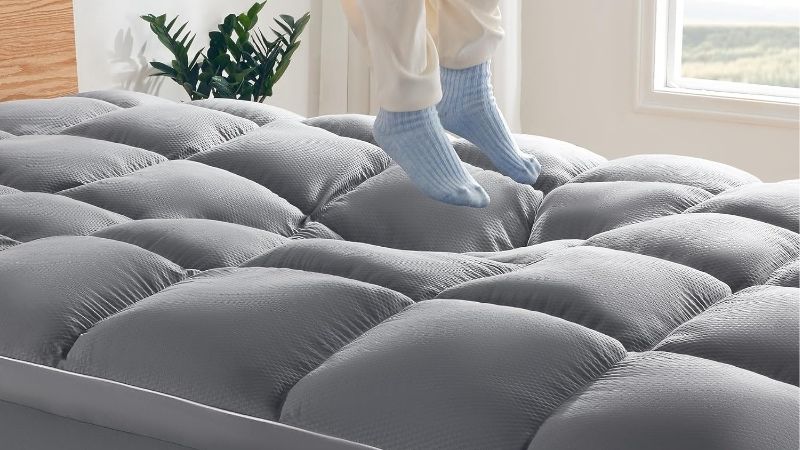
Quilted pads are under 1 in (2.5 cm) and change the feel of a bed very little. At 2 in (5 cm) a foam layer softens the surface noticeably; at 3-4 in (7.6-10 cm) it measurably redistributes pressure at the hips and shoulders, which is where most complaints originate.
Density matters as much as depth, since a thick low-density layer compresses to nothing under load within a year. For a bed that feels too hard, 3 in of higher-density foam does more than 4 in of soft fill, and it holds that difference for longer. Weight per size is again the practical proxy, since density is rarely printed on the listing itself.
What a Pad Cannot Fix
If your mattress has a visible dip, a pad follows the dip and can make the low spot feel deeper. No surface layer corrects a failed support core, and continuing to add foam over a sagging bed usually makes matters worse rather than better.
A pad also cannot make a bed firmer in any meaningful way. If your complaint is that the mattress is too soft and your hips sink, the honest answer is a firmer mattress or a plywood-style support board rather than anything laid on top. Adding softness to an already soft bed is the most common mistake made in this category.
Space and Fit: Depth, Sheets and Anchoring
Measure your mattress rather than trusting the size label, particularly on older or pillow-top beds. Adding 2-3 in (5-7.6 cm) means standard fitted sheets no longer reach, so deep-pocket sheets rated for the combined height are part of the purchase, not an afterthought.
Foam layers migrate on slick mattress protectors. Corner straps, a fitted skirt or a tight deep-pocket sheet keep everything aligned; combining straps with a proper sheet is the most reliable arrangement for anyone who moves around at night. Straps are worth rechecking after the first week, since they loosen as the foam settles into position.
Temperature, Washability and Certifications
Every layer between you and the mattress reduces airflow, so a bed that already sleeps warm will sleep warmer with foam on top. Ventilated foam, gel infusion and latex all help at the margin; quilted fibre pads breathe better than any solid foam does. In a bedroom that already runs warm, that difference is more noticeable than any gel infusion.
Quilted pads machine wash; foam layers do not and never should be soaked. Look for CertiPUR-US on foam products, expect 24-48 hours of expansion and mild off-gassing on compressed items, and plan for a protector on anything that cannot go in a machine. Buying it at the same time avoids sleeping on an unprotected foam layer for the first fortnight.
Top Picks: Six Pads and Thin Toppers Compared
The list below deliberately mixes true pads with foam layers, because the search term covers both and the right answer depends on your bed. Each entry names a real limitation, and specifications come from manufacturer documentation and aggregated owner reports rather than in-house testing. Which best mattress pad for back pain works depends entirely on whether your complaint is firmness or a failing core.
| Model | Type | Thickness | Washable | Best for |
|---|---|---|---|---|
| Zinus Green Tea Memory Foam Topper | Memory foam | 4 in / 10 cm | No | Hard beds needing real change |
| Serta Pillow-Top and Foam Combo | Foam plus fibre | 3 in / 7.6 cm | Cover only | Balanced cushioning |
| Sleep Innovations Gel Memory Foam | Gel memory foam | 2 in / 5 cm | No | Mild surface softening |
| Subrtex Gel Swirl Foam | Gel memory foam | 3 in / 7.6 cm | No | Mid-price pressure relief |
| Bedsure Quilted Mattress Pad | Fibre fill | Under 1 in / 2.5 cm | Yes | Smoothing and protection |
| SafeRest Waterproof Protector | Protector | Minimal | Yes | Protection only, no cushioning |
Zinus Green Tea Memory Foam Topper – Maximum Surface Change
Four inches of memory foam is the largest feel change available short of replacing the bed, and on a mattress that is simply too hard it works from the first night. The infused foam carries the same certification as the brand’s mattresses and expands fully within two days.
Four inches raises the bed noticeably and requires deep-pocket sheets rated for the total height. It also traps more heat than any thinner option here, and at this depth the layer can feel unstable to anyone who prefers a firm, planted surface.
Serta Pillow-Top and Foam Combo – Cushion Without the Sink
A fibre pillow-top quilted over a memory foam base gives immediate softness on the surface while the foam underneath handles pressure distribution. That combination avoids the fully enveloped sensation that makes some sleepers dislike plain memory foam entirely.
The fibre layer compresses over time in a way the foam does not, so the surface flattens before the foam wears out. Only the cover is washable on most versions, and the quilting can shift after a few machine cycles if it is washed too aggressively.
Sleep Innovations Gel Memory Foam – The Two-Inch Option
Two inches of gel-infused memory foam takes the hard edge off a firm mattress without significantly raising the bed height. For a mattress that is close to right but slightly unforgiving at the shoulders, two inches is often the correct amount of change.
Two inches will not rescue a genuinely hard bed, and it will not disguise a dip. There is no strap system on most versions, so pair it with a deep-pocket fitted sheet or expect it to shift toward the foot of the bed over time.
Subrtex Gel Swirl Foam – Mid-Price Pressure Relief
Three inches of gel memory foam in all standard US sizes at a mid-tier price, which is the depth most people should start with when the goal is to change how a bed distributes weight. The gel infusion moderates heat build-up without eliminating it.
Density sits in the middle of the market, so expect gradual compression under the hips after several years of nightly use. It ships compressed and needs a full 48 hours flat before it reaches its stated thickness in a cool bedroom.
Bedsure Quilted Mattress Pad – Protection and Smoothing
A fitted quilted pad with a deep skirt that smooths the surface, adds a thin barrier and washes in a normal machine. This is what a mattress pad traditionally means, and for a bed that feels harsh rather than hard it can be enough on its own.
It will not relieve pressure points or change firmness, which is the limitation to be clear about before ordering. Anyone whose actual complaint is a hard mattress should choose one of the foam layers above rather than this.
SafeRest Waterproof Protector – No Cushioning At All
A fitted waterproof protector with a breathable membrane, included here because it is frequently bought by mistake in this category. It protects the mattress and the warranty, and it adds no measurable padding whatsoever.
Waterproof membranes trap some warmth even when described as breathable, which is worth knowing if the bed already sleeps hot. Buy it alongside a foam layer rather than instead of one when the goal is comfort rather than protection.
Fitting, Care and Knowing When to Stop
Most disappointment with the best mattress pad for back pain comes from installation and expectation rather than the products themselves. Three practical areas cover nearly every complaint that surfaces a month after purchase, and one of them is knowing when a pad is the wrong answer entirely.
Getting the Layer to Stay Put
Give compressed foam 24-48 hours flat and unwrapped before judging it, since a corner that looks thinner on day one has usually levelled out by day three. Cold rooms slow expansion further, so allow extra time in winter. A layer still visibly uneven after three days is a genuine defect rather than a settling issue.
Anchor the layer with corner straps, a fitted cover or a deep-pocket sheet sized for the combined height. The best mattress pad for back pain relief is useless if it slides 4 in toward the foot of the bed every night.
Cleaning Without Ruining the Foam
Foam cannot be machine washed and should never be soaked, so spot clean with mild detergent and minimal moisture, then allow full air drying before bedding goes back on. Trapped moisture inside foam is what causes odour and eventual breakdown.
Quilted pads and protectors handle regular machine washing, which is their main advantage. Running a washable protector over a non-washable foam layer gives you the cushioning of one and the hygiene of the other in a single setup.
When the Mattress Is the Real Problem
If a new layer helped for a few weeks and then stopped, or if you can feel a dip through 3 in of foam, the support core has failed and no surface product will correct it. That is the point to budget for a mattress rather than another pad.
Persistent, worsening or radiating back pain is a medical question rather than a bedding one. A doctor or physiotherapist can assess causes that no product on this page addresses, and it is worth that conversation before spending repeatedly on surface layers.
See More:
- Best low price dash cam
- Projector screens at Best Buy
- Best buy projector screens
- Best projector for games
- Best projector for gaming
Final Thoughts on the Best Mattress Pad for Back Pain
Decide whether you need protection, mild softening or genuine pressure redistribution, because those are three different products at three different price points. Matching the layer to the actual complaint is what makes this category work.
The best mattress pad for back pain is one matched to a specific problem with a support core that is still flat underneath it. Measure your mattress and sheet depth before ordering, and check current pricing and available sizes on the listing at purchase.

Write Your Review
No reviews yet. Be the first to share your experience!