
Best nursery mattress choices are usually made once and lived with for three years, which is why the decision should be judged on longevity rather than on how the surface feels in a shop. Firmness, standard sizing and cleanability decide the outcome, and dual-stage construction decides whether it survives the toddler bed conversion.
As an Amazon Associate we earn from qualifying purchases.
Our top picks


As an Amazon Associate we earn from qualifying purchases at no extra cost to you.
By Daniel Foster
🛒 Best Price Today on Amazon
Prime members get fast, free shipping on everything above, plus member-only deals. New members get a 30-day free trial — cancel anytime.
Start 30-Day Prime Free Trial →See Today’s Amazon DealsHow to Choose the Best Nursery Mattress
The best nursery mattress has to satisfy two different users across two different stages: an infant who needs a firm, flat, bare surface, and a toddler who will jump on it. Planning for both from the start is what separates a single purchase from two.
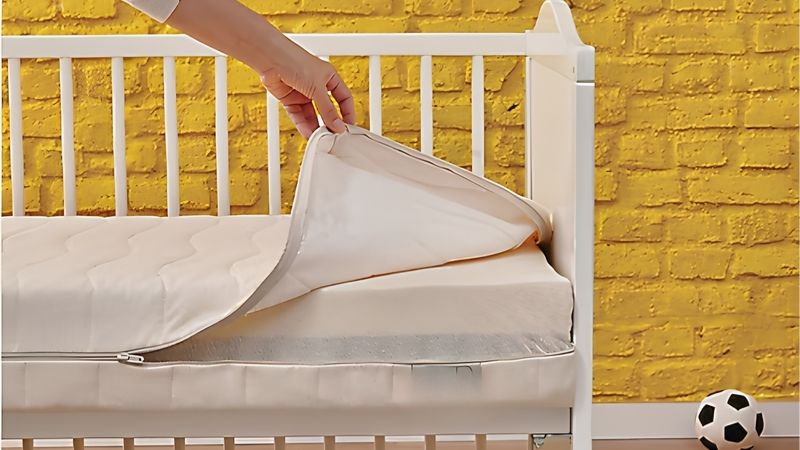
Firmness and Standard Sizing Come First
Firmness on an infant sleep surface is a safety requirement, not a comfort setting. The surface must stay flat under a baby’s weight, and any mattress that visibly contours is unsuitable regardless of how it is marketed. This never changes with brand, price or material. A firm surface is uncomfortable by adult standards, and that is the intended outcome rather than a compromise.
US full-size crib mattresses measure approximately 27.25 x 51.625 in (69 x 131 cm) with a maximum thickness of 6 in (15 cm). After fitting, no more than two adult fingers should slide between the mattress and the crib frame anywhere around the edge. Check that gap again after a few weeks, since sheets and protectors can shift the fit slightly.
Dual-Stage Design and Usable Lifespan
Dual-stage mattresses have a firm infant side and a slightly less firm toddler side, flipped when the child is old enough. That design is the main reason one mattress can cover the whole nursery period, and it costs relatively little compared with buying twice.
Single-firmness models remain entirely usable into the toddler years; the surface simply stays firm. If the price gap is significant, a well-built single-firmness mattress is a better purchase than a cheap dual-stage one with a low-density core that softens by month eighteen. Density is rarely printed on listings, so weight is the usable proxy: heavier foam cores generally hold firmness longer.
Space and Fit: Crib, Conversion and Room Layout
Measure the crib interior before ordering, since mini cribs, portable cribs and older frames differ from the US standard. Check the lowest mattress support setting too, because side rail height above the mattress is what matters once a baby can pull to standing.
If the crib converts to a toddler bed, confirm the same mattress carries over rather than assuming it does. Plan where a spare mattress or protector will be stored as well; nurseries are usually the smallest room in the house and the storage question arrives at 3am. A spare fitted sheet and a spare protector kept in the same room save a great deal of trouble on a bad night.
Waterproofing, Certifications and What Stays Off the Bed
Wipe-clean waterproof surfaces, removable washable covers and thin fitted protectors are the three viable cleaning approaches. Choose one before you need it, because the alternative is stripping a crib at night while holding a baby and discovering the cover is not machine washable.
Look for CPSC compliance, ASTM standards, GREENGUARD Gold for emissions and CertiPUR-US on foam cores. Keep the crib bare apart from a fitted sheet for the first twelve months: no pillows, quilts, padded protectors, bumpers or soft toppers of any kind. That list applies regardless of how firm the mattress underneath happens to be.
Top Picks: Six Nursery Mattresses Built to Last
The selection below spans foam, innerspring and hybrid cores across the price range, with a genuine limitation noted for each. Specifications come from manufacturer documentation and aggregated owner reports rather than in-house testing, and certifications should be verified on the individual listing. Which best nursery mattress makes sense depends mostly on whether you want a toddler side and how you intend to handle leaks.
| Model | Core | Dual-stage | Weight | Best for |
|---|---|---|---|---|
| Moonlight Slumber Little Dreamer | Foam | Yes | Light | Full nursery-to-toddler span |
| Dream On Me Spring Crib and Toddler | Innerspring | Yes | Medium | Firm edges on a budget |
| Safety 1st Heavenly Dreams | Foam | No | Very light | Second cribs, travel setups |
| Milliard Crib Mattress | Foam | Yes | Light | Washable cover priority |
| Babyletto Pure Core | Foam | No | Light | Certified low-emission build |
| Naturepedic Organic Breathable | Organic fill | Yes | Medium | Material sourcing priority |
Moonlight Slumber Little Dreamer – Dual-Stage Done Properly
A dual-firmness foam mattress with a seamless, water-resistant medical-grade cover that wipes clean without seams for liquid to enter. The infant side is genuinely firm, and the toddler side offers a modest change rather than the dramatic softening some competitors advertise.
It sits above the budget tier on price, and the two sides are similar enough in appearance that marking the infant side yourself is worthwhile. The seamless cover cannot be removed for machine washing, so a thin fitted protector is still the sensible addition.
Dream On Me Spring Crib and Toddler – Coils at a Budget Price
An innerspring core with a dual-sided design and a waterproof cover, priced well below most spring models. Coils hold perimeter firmness better than budget foam, which matters once a toddler is standing and leaning against the edges daily.
It is heavier than the foam options, so nighttime sheet changes take more effort. Coil counts at this price are at the lower end of the range, and the vinyl cover is functional but prone to marking, so handle it carefully when fitting sheets.
Safety 1st Heavenly Dreams – The Lightweight Standby
A very light foam core with a firm surface and a waterproof cover at the lowest price on this list. For a second crib at a grandparent’s house or a short-term setup, it meets the firmness and sizing requirements without an unnecessary outlay.
Low-density foam softens faster under daily use, so this is not the mattress to buy for three years of nightly service. Check firmness by hand every few months, and replace it rather than continuing if the surface no longer feels flat and rigid.
Milliard Crib Mattress – Removable Washable Cover
A dual-sided foam mattress with a removable, machine-washable cover, which is the practical differentiator here. Replacement covers are sold separately for some models, which extends the life of an otherwise sound mattress. Being able to run the cover through a normal wash after a leak saves considerable effort compared with wiping and waiting for a sealed surface to dry.
The foam core itself is not washable and must never be soaked, so spills need catching before they reach it. Density sits in the mid range, making this a solid three-year mattress rather than something that will pass to a second child in good condition.
Babyletto Pure Core – Certified and Simple
A lightweight foam core with GREENGUARD Gold certification and a straightforward firm surface, available with or without a waterproof cover depending on the version. Buying the cover separately lets you replace it later rather than replacing the whole mattress.
The uncovered version needs a protector from day one, which is an extra cost that is easy to overlook when comparing prices. It is also single firmness, so there is no softer toddler side later, though that is rarely a practical problem.
Naturepedic Organic Breathable – Certified Materials, Premium Price
An organic cotton filled core with a breathable, waterproof surface and extensive third-party certification covering both content and emissions. The construction quality is evident in the edges and seams, which hold shape better than most foam cores across several years.
The price is substantially above everything else here, and organic sourcing does not make a sleep surface safer than a certified conventional one. The safety-critical factors, firmness and fit, are equally satisfied by several cheaper mattresses on this list.
Cleaning, Safety Checks and the Toddler Transition
The best nursery mattress is tested by leaks, illness and eventually by jumping. The routines below cover the three phases and prevent the most common outcome, which is a mattress replaced early because moisture reached a core that could not dry.
Cleaning Without Damaging the Core
Wipe waterproof surfaces with mild soap and water and dry them completely before replacing the sheet, paying attention to seams and corners where moisture collects. Machine-washable covers should be removed promptly rather than left damp on the mattress overnight.
Never soak a foam or fibre core, and never use a padded quilted protector in a crib. A thin fitted waterproof protector adds a washable barrier without introducing the soft layer that safe sleep guidance specifically excludes for babies under twelve months.
Routine Firmness and Recall Checks
Press the centre and each corner with a flat hand every couple of months and compare it with how the mattress felt when new. A visible depression, any softening or any seam separation means replacement rather than continued use with a thicker sheet over it.
The CPSC publishes recalls for infant products, and checking a model number takes a minute. Second-hand crib mattresses are the one item worth avoiding entirely, since firmness history, storage conditions and recall status are all unknown to the buyer.
Moving to a Toddler Bed
Flip dual-stage models to the toddler side only when the child is past twelve months and the manufacturer’s guidance allows it. Single-firmness mattresses carry over unchanged, and most toddlers adapt to a firm surface without any complaint at all. The transition is usually harder for the parents than it is for the child.
Nursery purchases cluster around baby shower season and the November gifting period, so specific certified models can go out of stock at those times. Selecting the best nursery mattress a few weeks before it is needed avoids settling for whatever is available that week.
See More:
- Best low price dash cam
- Projector screens at Best Buy
- Best buy projector screens
- Best projector for games
- Best projector for gaming
Final Thoughts on the Best Nursery Mattress
Firmness, standard sizing and a cleaning method you will actually use are the three decisions that matter. Dual-stage construction is worth paying for when the price gap is modest, and certification is worth checking on the listing rather than assuming from the brand.
The best nursery mattress is the one that stays firm and flat for three years and cleans up quickly at 3am. Measure the crib interior before ordering, confirm the two-finger fit after delivery, and keep the surface bare apart from a fitted sheet.

Write Your Review
No reviews yet. Be the first to share your experience!