
Best no subscription security camera shopping is really a storage question. Cameras that record to a microSD card, a base station or a network recorder keep working without a monthly plan, and this guide compares seven of them on exactly what you lose when you decline the cloud.
As an Amazon Associate we earn from qualifying purchases.
By Daniel Foster
Where the Subscription Actually Hides
The best no subscription security camera is not a special product category; most security cameras record perfectly well without a plan. What a subscription usually buys is cloud retention, person and package detection, and longer event history, and manufacturers vary enormously in how much of that they lock behind the paywall. Reading the fine print before purchase is the whole exercise.
The Decisive Numbers: Power, Storage and Subscription Cost
Power source comes first because it dictates everything else. Wired cameras record continuously; battery cameras record only motion events to preserve charge, typically lasting three to six months per charge; solar panels extend that indefinitely in reasonable sunlight but not through a northern winter.
Storage capacity decides how far back the record goes. Cameras taking microSD usually accept 128-512 GB, which holds weeks of event clips or a few days of continuous 2K recording. Hub-based systems with 8-16 TB drives store months, which is the real advantage of a base station over a card in each camera when you want a genuinely subscription-free record.
The subscription figure itself belongs in the buying decision. Plans commonly run from a few dollars a month for one camera to a larger monthly figure for a whole property, and over three years that recurring cost frequently exceeds the hardware price. A best no subscription security camera setup trades that spend for a one-time storage purchase.
Space and Fit: Mounting, Wiring and Coverage
Installing the best no subscription security camera still means solving the same physical problems, and wired cameras need a route for the cable. Power-over-Ethernet models carry data and power on one run, which is tidy but requires either an existing cable path or a willingness to drill; standard wired cameras need an outdoor-rated outlet within reach of the supplied lead.
Battery cameras mount anywhere but need to come down for charging unless paired with a solar panel, so height matters more than it seems. Mounting at 8-10 ft (2.4-3 m) gives good coverage and deters tampering, but anything above that means a ladder every few months. Weather ratings of IP65 or better are the baseline for outdoor use.
What Fails and What It Costs to Run
MicroSD cards are consumables under continuous recording, and standard cards fail silently after a year or two of constant rewriting. High-endurance cards rated for video surveillance last considerably longer, and any camera relying on local storage should be checked periodically to confirm it is still writing.
Batteries degrade over charge cycles, so a camera delivering four months when new may manage two after three years, and few manufacturers sell replacement cells. Wifi reliability is the other common failure: 2.4 GHz reaches further through walls than 5 GHz, and a camera at the edge of coverage drops recordings without any obvious warning.
7 Cameras That Work Without a Monthly Plan
The best no subscription security camera for a given property depends on whether you can run cable. These picks span battery, wired and hub-based systems; Amazon prices move constantly, so treat tiers as approximate.
| Model | Power | Local storage | Price tier |
|---|---|---|---|
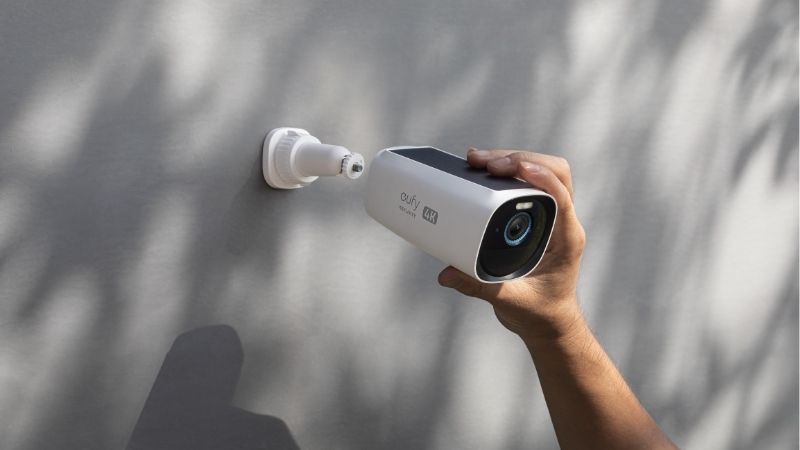
| eufyCam 3 (S330) | Battery + solar | HomeBase, expandable | Premium |
| Reolink Argus 4 Pro | Battery + solar | microSD | Mid |
| Reolink RLC-811A | PoE wired | microSD or NVR | Mid |
| TP-Link Tapo C425 | Battery + solar | microSD or hub | Mid |
| Wyze Cam v4 | Wired | microSD | Budget |
| Amcrest UltraHD IP | PoE or wired | microSD or NVR | Budget-mid |
| Lorex 2K Wired | Wired | microSD or DVR | Mid |
eufyCam 3: Hub Storage Done Properly
This is the closest thing to a turnkey local-storage system. The HomeBase records locally with expandable storage, and on-device person and face recognition run without any cloud processing, which is the specific thing most competitors charge for. Solar panels built into the cameras keep them topped up in reasonable light.
The system costs more up front than single cameras, and the value only makes sense across several units. Some newer features have drifted towards optional cloud services over time, so check current terms rather than assuming the original no-fee position still holds in full.
Reolink Argus 4 Pro: Battery With a Card Slot
A wide-angle battery camera that records to its own microSD with no hub required, plus solar panel support and colour night vision. For a single problem spot at the side of a house with no power nearby, this is the least complicated answer.
Battery cameras record events rather than continuously, so gaps between clips are inherent to the design. The app is functional but dense, and retrieving footage means going to the camera’s card or pulling it over wifi, which is slower than a cloud timeline.
Reolink RLC-811A: Continuous Recording Over PoE
Power over Ethernet means one cable, continuous 4K recording, and no batteries to manage. It supports RTSP and ONVIF, so it works with third-party network video recorders and open-source software rather than locking you into one app.
Installation is the barrier: a cable run from a switch or injector to each camera position, which is straightforward in a new build and awkward in a finished house. The camera also needs an NVR or a computer running recording software to store more than a card holds.
TP-Link Tapo C425: Value Battery Camera
A magnetic mount, solar option and microSD slot at a price below the established security brands, with a reliable app and 2K recording. For a first outdoor camera it covers the essentials without a hub purchase.
Advanced detection categories are tied to the optional subscription, so the free experience is motion alerts rather than person or vehicle classification. Battery life depends heavily on how much motion the camera sees, and a busy street-facing position drains it quickly.
Wyze Cam v4: The Budget Entry
Recording to microSD costs nothing beyond the card, and continuous local recording is available on the free tier. For an indoor camera or a covered porch, the price makes it easy to place several.
Cloud event clips and some detection features require the paid plan, and Wyze has changed its free tier terms more than once, so verify what is currently included. Build quality is light and the wired-only power means an outlet within cable reach.
Amcrest UltraHD IP: Open Standards
Full ONVIF and RTSP support makes this camera usable with almost any network video recorder or open-source platform, which is the strongest guarantee of independence from any single company’s pricing decisions. PoE and standard wired variants are both available.
The setup process assumes some networking familiarity, and the mobile app is dated compared with consumer brands. There is no polished onboarding experience, which is the trade for the flexibility.
Lorex 2K Wired: Kit-Based Local Recording
Lorex sells camera and recorder kits designed around local storage from the outset, with no subscription required for core recording or playback. For someone who wants a multi-camera system as a single purchase, that packaging is the appeal.
The recorder needs a permanent home with ventilation and a network connection, and the hardware is bulkier than a hub-based consumer system. Some remote-access conveniences have shifted towards optional paid tiers, so read the current terms.
Running a Local-Storage System Well
Choosing the best no subscription security camera is the first step; keeping the footage available when it matters is the ongoing part.
Storage Management and Redundancy
The best no subscription security camera setup has one weakness a cloud plan does not: a thief who takes the camera takes the footage. Hub and recorder systems solve this by keeping the storage indoors, which is a strong argument for a base station over a card in each outdoor unit.
Use high-endurance microSD cards rated for surveillance and check quarterly that the camera is still recording, since silent card failure is common and rarely alerts. Some systems support a secondary backup to a network drive, which costs nothing recurring and covers the theft scenario.
Privacy and Network Considerations
Local recording keeps footage off third-party servers, which is a large part of why people search for these cameras in the first place. Keeping cameras on a separate network segment or guest network further limits what a compromised device can reach.
Change default passwords, enable two-factor authentication where offered, and keep firmware current. Cameras that support RTSP and ONVIF can run entirely inside your own network with no internet access at all, which is the strongest privacy position available in this category.
Seasonal Demand and When to Buy
Security cameras track the general electronics calendar, with Prime Big Deal Days in early October and Black Friday and Cyber Monday in late November as the next two windows where discounts across this category are most consistent.
Demand also rises in autumn as evenings darken and parcel theft becomes a seasonal concern, and again before holiday travel when people want to watch an empty house. Buying ahead of those periods is generally easier than during them. Measure the distance from your intended mounting point to the nearest outlet or network point before ordering.
Frequently Asked Questions
These come up whenever best no subscription security camera research moves from marketing pages to fine print.
What do I actually lose without a subscription?
Usually cloud retention, longer event history and some AI detection categories such as package or face recognition. Live view, motion alerts and local recording generally continue to work, but the split varies by brand, so confirm the free feature list for the specific model.
Is local storage safe if the camera is stolen?
Not on its own. A card inside an outdoor camera goes with the camera. Systems that record to an indoor hub or a network recorder keep the footage even if a unit is removed, which is the main practical advantage of that architecture.
Battery or wired for a no-fee setup?
Wired if you want continuous recording and never want to think about charging; battery if the position has no power and you accept event-based clips. Solar panels make battery cameras practical year-round in sunny climates and less so at high latitudes in winter.
See More:
- Best noise cancelling headphones Bose
- Best deal on air fryer
- Best buy Bella air fryer
- Best deals air fryer
- Best blender bottle
Final Thoughts on Avoiding Camera Fees
The best no subscription security camera is one that records to storage you own, ideally indoors, with a documented free feature set you have read before buying. Check the current terms rather than the reputation, use high-endurance cards, and measure the run to power or network before ordering. Over three years the saved fees usually exceed what the hardware cost.
Our top picks


 Security Cameras Wireless Outdoor 5G& 2.4G
- Connectivity Technology: Wireless
- Video Capture Resolution: 1944p, 4MP
- Number of Channels: 4
128GB local storage avoids any monthly subscription fees
IP66 protection withstands all-weather outdoor exposure
AI human detection sends alerts for people, not all motion
Solar power depends on consistent sunlight exposure
128GB storage limits loop recording to about 3 months


As an Amazon Associate we earn from qualifying purchases at no extra cost to you.





Write Your Review
No reviews yet. Be the first to share your experience!