
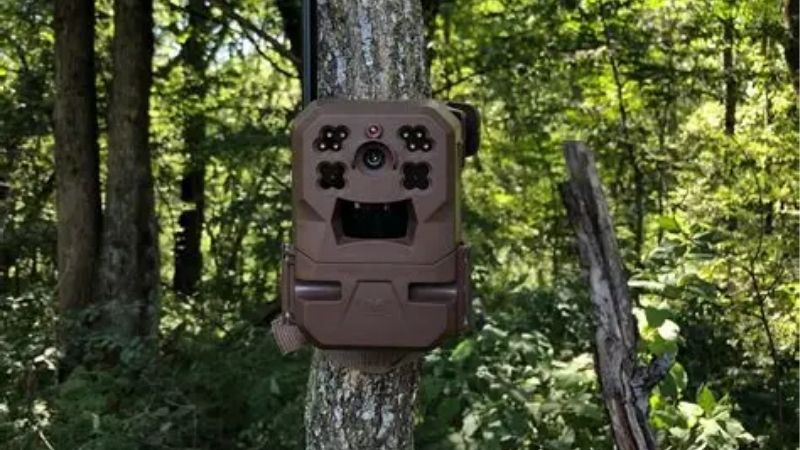
Best trail camera for security is the answer when there is no wifi and no power, which describes most gates, driveways, outbuildings and back fences. Trail cameras run on AA cells for months and either store to a card or send images over a cellular network.
As an Amazon Associate we earn from qualifying purchases.
By Daniel Foster
Where a Trail Camera Beats a Security Camera
The best trail camera for security wins where conventional cameras cannot go, because those assume mains power and a wifi signal. A trail camera assumes neither, which makes it the practical option for a position 200 ft (60 m) from the house. The trade-off is that you get still images or short clips on a delay rather than live video.
The Decisive Numbers: Power, Storage and Subscription
Power comes from AA cells, typically 8 to 12, and lithium cells rather than alkaline are the meaningful upgrade because they hold voltage in the cold and last far longer. A camera in a low-traffic position can run six to twelve months on one set.
Storage is a microSD card, usually supporting 32-512 GB depending on model. Cards fill with images rather than continuous video, so capacity lasts far longer than on a security camera, though a card facing a busy road will fill in days from vehicle triggers.
Subscription applies only to cellular models, and it is where the ongoing cost sits. Plans are priced by images per month, and a camera on a driveway can burn through an allowance quickly. The best trail camera for security on a tight budget is often a non-cellular model checked weekly.
Space and Fit: Mounting, Detection Zone and Theft
Mount the best trail camera for security at 3-6 ft (0.9-1.8 m) and angle it slightly downward across the approach rather than straight at it, because passive infrared detects movement across the sensor’s field better than movement directly towards it. That single adjustment fixes most missed triggers.
Detection ranges are typically 60-100 ft (18-30 m), which is far beyond a typical driveway. Cameras are also a theft target themselves, so a steel security box and a cable lock through the mounting point are worth the modest extra cost in an accessible position.
Trigger Speed, Flash Type and Failure Points
Trigger speed is what separates the best trail camera for security from a wildlife camera. A person walking past at 3 mph is gone in a second, so a camera at 0.1-0.4 seconds captures them while one at 1 second frequently records an empty frame. Recovery time between shots matters equally.
Flash type determines whether the camera is noticed. Low-glow infrared shows a faint red glow at night; no-glow black infrared is invisible but produces shorter range and darker images. On durability, the battery door seal and the SD card slot are the usual failure points, and condensation inside the housing is common in humid climates.
7 Trail Cameras Suited to Property Monitoring
The best trail camera for security is cellular or card-only depending on how often you visit. These mix both across price tiers. Amazon prices change frequently, so treat the tiers as approximate and check current plan pricing separately.
| Model | Connectivity | Flash | Price tier |
|---|---|---|---|
| Tactacam Reveal X Gen 2.0 | Cellular | No-glow | Mid |
| SPYPOINT Flex | Cellular, dual carrier | Low-glow | Mid |
| Bushnell CelluCORE 20 | Cellular | Low-glow | Mid |
| Browning Strike Force Pro X | Card only | Low-glow | Mid |
| Moultrie Edge 2 | Cellular | Low-glow | Mid |
| Stealth Cam Fusion X Pro | Cellular | No-glow | Mid-premium |
| Reconyx HyperFire 2 | Card only | No-glow | Premium |
Tactacam Reveal X Gen 2.0: Popular Cellular Option
No-glow infrared and a straightforward app make this a common choice for gates and driveways, with plan tiers that scale from occasional checking to heavy use. Setup is among the simplest in the cellular category.
Image quality at night is moderate because no-glow flash is inherently dimmer. Cellular coverage at the mounting point determines whether it works at all, and rural positions sometimes need an external antenna.
SPYPOINT Flex: Dual Carrier Coverage
The camera selects between two carrier networks, which materially improves the chance of a usable signal in a marginal position. A free plan tier exists for a small number of images per month, which suits low-traffic monitoring.
Low-glow flash produces better night images than no-glow but is visible as a faint red light. The free tier fills quickly on a busy approach, pushing you to a paid plan.
Bushnell CelluCORE 20: Simple and Reliable
A no-nonsense cellular camera with dependable trigger performance and a clear app, suited to someone who wants notifications without configuring much. Battery life is good in a low-traffic position.
Resolution and night image quality are middling, and there is no video streaming. The plan structure is straightforward but adds up across several cameras on a property.
Browning Strike Force Pro X: Card-Only Speed
Very fast trigger speed and short recovery between shots, which is exactly what security use requires, in a compact card-only body with no ongoing cost. Battery life on lithium cells is excellent.
No cellular means physically visiting the camera to retrieve images, which is fine for a gate you pass daily and useless for a remote plot. Low-glow flash is visible at night.
Moultrie Edge 2: Balanced Cellular
Built-in cellular with no separate SIM to configure, an integrated antenna and reasonable image quality. The app handles multiple cameras cleanly, which matters if you are covering several points.
Trigger speed is adequate rather than fast, so quick-moving subjects occasionally clip the frame edge. Plan costs scale per camera, which becomes significant across a property.
Stealth Cam Fusion X Pro: Covert and Capable
No-glow infrared with solid resolution and fast triggering, plus solar panel compatibility that removes the battery-changing trip. For a position you would rather nobody noticed, this is a strong combination.
It sits at the higher end of mainstream pricing, and no-glow flash still limits effective night range. The app has more configuration than casual users need.
Reconyx HyperFire 2: Professional Build
Extremely fast trigger, no-glow flash, exceptional battery life and a housing built for years outdoors rather than a season. Where reliability genuinely matters, this is the reference.
The price is several times that of consumer cameras and there is no cellular in this model, so images must be collected in person. Resolution is lower than cheaper competitors, prioritising speed and consistency instead.
Using a Trail Camera Responsibly and Effectively
The best trail camera for security runs for months unattended, provided the setup and the legal position are right.
Placement That Actually Captures People
Angle across the path of travel rather than along it, mount at chest height for a clear face capture, and avoid pointing at a road or a sunlit gap that triggers constantly. A camera generating hundreds of empty images will be switched off within a fortnight.
Use lithium AA cells rather than alkaline, particularly in winter, and format the card in the camera each time you swap it. Check the seal on the battery door, since water ingress and condensation are the most common ways these cameras die.
Privacy and Legal Boundaries
Point the camera at your own property and avoid framing a neighbour’s house, garden or a public footpath, since rules on recording beyond your boundary vary considerably by jurisdiction. Audio recording is separately regulated in many places and often more strictly.
Cellular cameras transmit images to a company’s servers, so understand what is retained and for how long. If a camera is intended to support an insurance claim or a police report, keep original files rather than app screenshots.
Costs, Plans and Buying Timing
Add up the annual plan cost across every camera before committing to cellular, since three cameras on a mid-tier plan often costs more per year than the cameras did. Card-only models on a route you walk regularly avoid that entirely.
Trail cameras follow hunting season demand, with the strongest availability and discounting from late summer through autumn as the season approaches. Prime Big Deal Days in early October and Black Friday and Cyber Monday in late November also cover this category.
Frequently Asked Questions
These come up when the best trail camera for security is bought for a driveway rather than a deer trail.
Do I need cellular?
Only if you cannot visit the camera regularly. Cellular gives near-immediate notification but carries a monthly plan per camera; a card-only model on a gate you pass daily costs nothing to run and often has better image quality for the money.
No-glow or low-glow flash?
No-glow is invisible at night and better where discretion matters, at the cost of shorter range and darker images. Low-glow gives clearer night photographs but shows a faint red light that alerts anyone paying attention.
Will it capture a face or a plate?
A face at close range in daylight, usually yes. A number plate at night, usually no, because infrared flash and moving vehicles rarely combine well. For plates specifically, a dedicated camera positioned close to the approach at a shallow angle is a better tool.
See More:
- Best noise cancelling headphones Bose
- Best deal on air fryer
- Best buy Bella air fryer
- Best deals air fryer
- Best blender bottle
Final Thoughts on Trail Cameras for Property
The best trail camera for security is fast-triggering, runs on lithium AA cells, and matches your access pattern: cellular if the position is remote, card-only if you pass it regularly. Mount at chest height across the approach, use a lock box in accessible spots, and point it at your own property rather than a neighbour’s.
Our top picks


As an Amazon Associate we earn from qualifying purchases at no extra cost to you.





Write Your Review
No reviews yet. Be the first to share your experience!