
K cup coffee maker best lists usually skip the three numbers that decide the purchase: reservoir size in ounces, the cup sizes the machine can actually pour, and the footprint it occupies on your counter. This guide compares six pod brewers on those specs and on running cost.
As an Amazon Associate we earn from qualifying purchases.
Our top picks


As an Amazon Associate we earn from qualifying purchases at no extra cost to you.
By Daniel Foster
Specifications come from manufacturer documentation and long-term owner feedback rather than lab testing. Prices move constantly, so models are described as budget, mid-range or premium.
🛒 Best Price Today on Amazon
Prime members get fast, free shipping on everything above, plus member-only deals. New members get a 30-day free trial — cancel anytime.
Start 30-Day Prime Free Trial →See Today’s Amazon DealsWhat Makes a K Cup Coffee Maker Best for Your Kitchen
Pod machines look interchangeable in listing photos, so the differences that matter get buried under marketing language. Four specifications separate the k cup coffee maker best suited to your household from one that annoys you by month three.
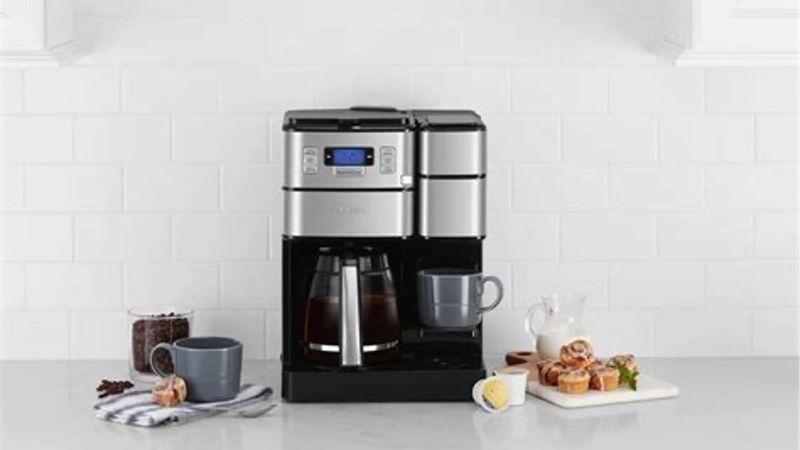
Brew Type, Cup Size and Reservoir Capacity
Start with the decisive trio: brew type, capacity and footprint. Single-serve pod machines pour roughly 4 to 12 oz (120 to 355 mL). Reservoirs range from none at all on the smallest models to 78 oz (2.3 L), which is about six to seven 12 oz cups before a refill.
A 42 oz (1.2 L) tank is fine for one person who drinks two cups a day. Two coffee drinkers with travel mugs will refill a small tank daily, which is exactly the friction that pushes people back to drip. Which k cup coffee maker best fits your morning depends far more on that number than on brand.
Counter Footprint and Where the Machine Actually Fits
Pod brewers are deceptively tall. Most full-size models stand 12 to 14 in (30 to 36 cm) high, and the lid needs several more inches of clearance to swing open under a wall cabinet. Slim models drop to about 5 in (13 cm) wide but give up the reservoir entirely.
Measure the counter depth, the width of the gap you plan to use, and the height to the underside of the cabinet before you order anything. Also check drip-tray clearance: many machines take a 7 in (18 cm) travel mug only after you remove the tray, which is worth confirming if a tumbler is your default vessel.
Pod Cost, Reusable Filters and Total Cost of Ownership
Pods are the real expense. Buying by the pod rather than in bulk boxes roughly doubles the cost per cup, and proprietary flavors carry a premium over supermarket house brands. Over a year of two cups a day, that gap outweighs the price difference between most machines on this list.
A reusable filter basket changes the arithmetic. Most Keurig machines accept the My K-Cup style basket, which lets you brew ground coffee at supermarket prices when you want. Confirm compatibility before assuming it works, since a few compact models and multi-format brewers use their own basket.
Temperature, Strength Controls and Cup Quality
The Specialty Coffee Association recommends brew water between 195 and 205 degrees F (90 to 96 C). Basic pod machines run a fixed temperature that sits at the low end, which is one reason pod coffee can taste thin next to pour over at the same dose.
Adjustable temperature and a strong-brew setting help, and multi-needle designs that pierce the pod in several places wet the grounds more evenly. None of this turns a pod into specialty coffee, but it narrows the gap enough that most drinkers stop noticing on a weekday morning.
Six Pod Brewers Worth Comparing
The k cup coffee maker best for a dorm shelf is rarely the right one for a family of four, so these six cover dorm-sized through multi-format. Every entry lists a drawback, because trade-offs decide which machine belongs on your counter.
| Model | Reservoir | Cup sizes | Best for |
|---|---|---|---|
| Keurig K-Elite | 75 oz / 2.2 L | 4-12 oz | Two or more drinkers |
| Keurig K-Supreme Plus | 78 oz / 2.3 L | 4-12 oz | Even extraction, travel mugs |
| Keurig K-Mini | None, fill per cup | 6-12 oz | Dorms, tight counters |
| Keurig K-Duo Plus | 60 oz / 1.8 L | Cup or 12-cup carafe | Mixed households |
| Instant Dual Pod Plus | 68 oz / 2 L | Pods, capsules, grounds | Multi-format kitchens |
| Cuisinart SS-10 | 72 oz / 2.1 L | 4-12 oz | Programmable simplicity |
Keurig K-Elite: The Default Full-Size Choice
The K-Elite pairs a 75 oz (2.2 L) removable reservoir with five brew sizes from 4 to 12 oz, adjustable temperature, a strong-brew button and an iced setting that brews hot and concentrated over ice, covering most household patterns.
The drawback is bulk. At roughly 13 in (33 cm) tall with the handle closed it needs real clearance under a cabinet, and the pump is audibly louder than newer models. Owners who keep it for years usually credit consistent descaling rather than any inherent durability advantage.
Keurig K-Supreme Plus: Better Extraction From the Same Pod
The K-Supreme Plus uses a multi-needle head that pierces the pod in several places instead of one, wetting grounds more evenly. It carries a 78 oz (2.3 L) tank, strength and temperature settings, and a reservoir that can sit at the side to reduce depth on a narrow counter.
It sits at a premium price for what is still pod coffee, and the housing is plastic under the metallic finish. Owners also report the multi-needle head needs more attention during cleaning, since coffee residue collects around the extra piercing points.
Keurig K-Mini: Under 5 Inches Wide
At about 4.5 in (11.5 cm) wide, the K-Mini is the model that fits where nothing else does: a dorm shelf, an office cubicle, the strip of counter beside a sink. It brews 6 to 12 oz and stores its cord in the base for travel.
There is no reservoir, so you pour fresh water for every cup, and the machine goes through a heat cycle each time. For one person who drinks one cup a morning that is a fair trade. For anyone brewing back to back it is the fastest route to regret.
Keurig K-Duo Plus: Pods and a Full Carafe
The K-Duo Plus brews a single cup from a pod or a full 12-cup carafe from ground coffee, drawing from a 60 oz (1.8 L) tank that can be positioned behind or beside the unit. The carafe is thermal rather than glass on a hot plate, so coffee is not slowly cooked while it waits.
It is the tallest and most expensive machine here, and the two brewing paths mean two cleaning routines. Households where one person wants a mug and another wants a pot get real value; a single drinker is paying for capability that stays unused.
Instant Dual Pod Plus: Three Formats in One Body
This one accepts K-Cup style pods, Nespresso-style capsules and ground coffee through an included basket, drawing from a 68 oz (2 L) reservoir. For a household split between pod coffee and espresso-style capsules it removes the need for two appliances and two counter positions.
Flexibility costs simplicity. There are more parts to store and clean, and the capsule side produces a small concentrated shot rather than cafe espresso from a 9 bar machine. Expect to keep the manual nearby for the first fortnight while the button logic becomes habit.
Cuisinart SS-10: Programmable and Straightforward
The SS-10 offers a 72 oz (2.1 L) reservoir, five cup sizes from 4 to 12 oz, a charcoal water filter and a programmable clock with auto-on, so it can be ready before you reach the kitchen. It is the least fussy machine on this list to operate.
The design is dated next to newer models and there is no iced or specialty mode. Owners who report early failures most often describe a weakening pump, which is the classic symptom of skipped descaling in a hard-water area rather than a design flaw.
Descaling, Failure Points and Long-Term Ownership
Pod brewers fail in predictable ways, and almost all of them trace back to water. Understanding the pattern tells you more about a machine’s real lifespan than any warranty statement on the box.
Scale Is the Main Cause of Slow, Weak Brewing
Calcium builds inside the heating element and narrows the water path. The symptoms arrive gradually: shorter pours, a machine that sounds strained, coffee that comes out cooler than it used to. Most manufacturers ask for descaling every three to six months depending on water hardness.
In a hard-water region, quarterly is the realistic interval, and a filtered water pitcher slows the process considerably. Machines with a charcoal filter in the reservoir handle taste, not minerals, so they do not remove the need to descale on schedule.
Needles, Pumps and the Two-Year Mark
The second common failure is a clogged entry or exit needle, which shows up as a pod that overflows or a brew that trickles. A straightened paperclip through the needle during cleaning prevents most of it, and multi-needle heads need this attention more often.
Pumps generally weaken rather than die outright, most often somewhere past the first year of daily use. Owner reports converge on the same conclusion across brands: the machines that reach year four are the ones whose owners descaled on schedule from the beginning.
Warranty, Parts and Electrical Certification
Warranty on pod brewers is typically one year and covers the unit rather than the carafe or filter basket. Read whether descaling records are expected, because manufacturers do decline claims that show heavy scaling.
Check for UL or ETL certification on any heated counter appliance, and buy carafes and reusable baskets from the brand rather than unbranded lookalikes, where seal quality varies. Late summer is when back-to-college listings appear, a reasonable moment to look at compact models.
Frequently Asked Questions
Three questions come up repeatedly from readers deciding which k cup coffee maker best fits their kitchen, and each has a straightforward answer once the specifications are on the table.
Can I use ground coffee instead of pods?
On most Keurig models yes, using a reusable basket sold separately, and the K-Duo and multi-format machines include ground coffee brewing natively. Compatibility is not universal, so confirm the specific model number accepts a reusable filter before counting on it as your cost-saving plan.
Does a bigger reservoir make better coffee?
No. Reservoir size affects how often you refill, nothing else. Cup quality depends on brew temperature, how evenly the pod is wetted and the coffee inside it. A large tank on a basic machine simply means more mediocre cups between trips to the sink.
How long should one of these last?
With regular descaling, several years of daily use is a realistic expectation across brands at this price level. Without it, performance decline often starts inside the second year. Water hardness in your area is the single biggest variable in that outcome.
See More:
- Best low price dash cam
- Projector screens at Best Buy
- Best buy projector screens
- Best projector for games
- Best projector for gaming
Final Thoughts on Choosing a Pod Brewer
The k cup coffee maker best suited to a single drinker in a small apartment is not the one that suits a family kitchen, and no ranking changes that. Match the reservoir to how many cups leave the machine before someone refills it, then confirm the height and depth against your actual counter.
If you want one recommendation to start from, the K-Elite covers the widest range of households, the K-Mini solves genuinely tight spaces, and the K-Duo Plus is the answer when one person wants a mug and another wants a pot. Whichever k cup coffee maker best matches your routine, budget for descaling supplies and a reusable filter from day one, since those two habits decide how long it lasts.





Write Your Review
No reviews yet. Be the first to share your experience!