Monitor buying guide advice is often a spec dump, when what you need is a clear path to the right screen. This monitor buying guide breaks down the four numbers that decide everything, then matches a display to office, gaming or creative use so you buy once and buy well.
As an Amazon Associate we earn from qualifying purchases.
Our top picks

 Philips 24 Inch Computer Monitor FHD 100Hz
- Aspect Ratio: 16:9
- Screen Finish: Glossy
- Contrast Ratio: 3000:1
VA panel delivers deep blacks and 3000:1 contrast
178-degree viewing angle keeps colors consistent off-axis
Backed by a 4-year advance replacement warranty
Peak brightness is rated at 250, a modest level
Only one HDMI and one VGA port are available
 Acer 27in FHD 1920x1080 IPS 120Hz Gaming
- Aspect Ratio: 16:9
- Screen Finish: Matte
- Contrast Ratio: 100000000:1
99% sRGB coverage keeps colors accurate for creative work
Adaptive-Sync support reduces screen tearing during gaming
1ms response time cuts down on motion blur
Resolution is limited to 1920x1080 at 27 inches
Brightness is rated at 250 nits, a modest level
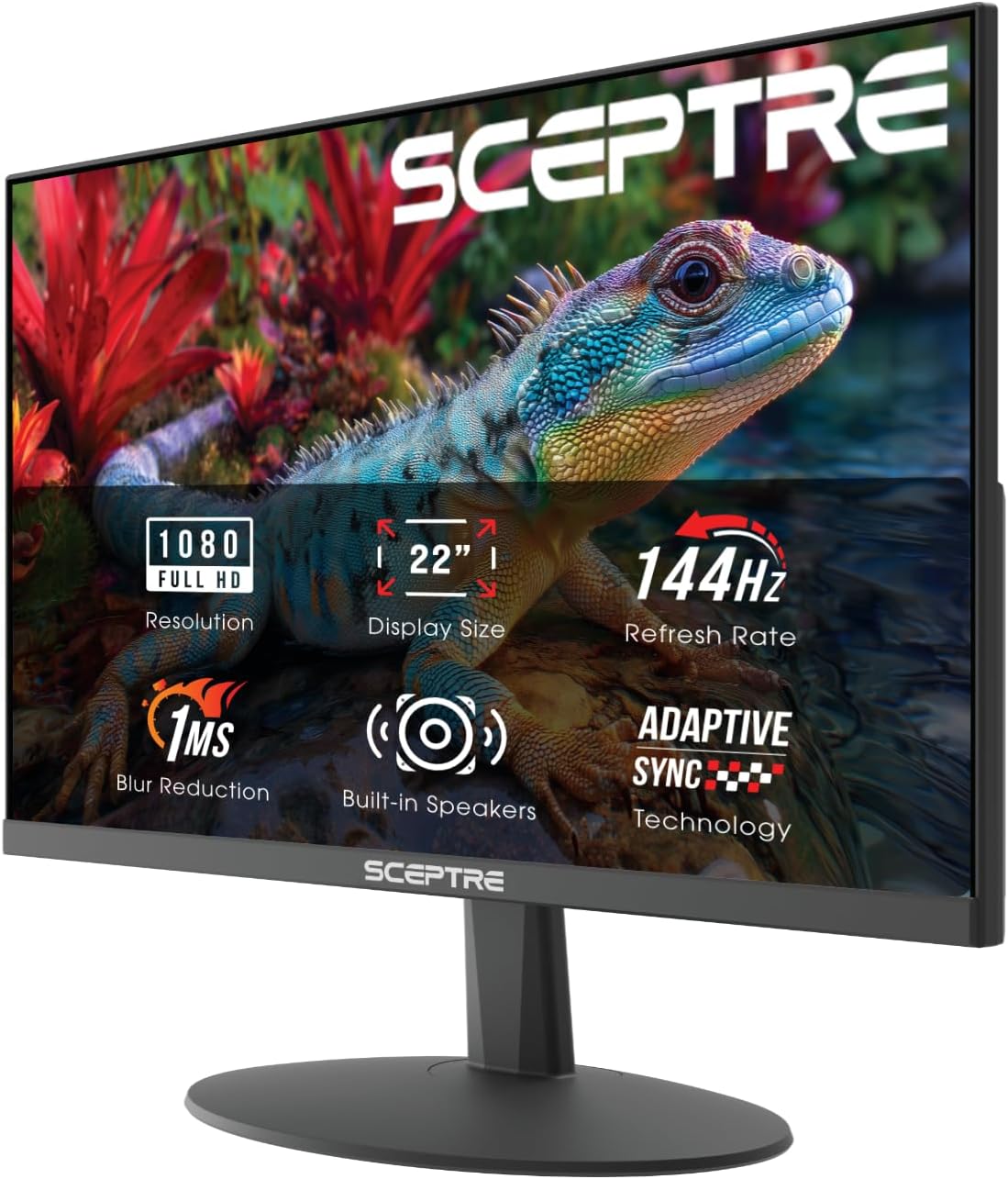 Sceptre New 22-Inch Gaming Monitor
- Aspect Ratio: 16:9
- Screen Finish: Matte
- Contrast Ratio: 2000:1
Up to 144Hz refresh rate smooths fast-motion gaming
Built-in speakers skip the need for external ones
Blue-Light Shift technology eases long-session eye strain
22-inch size may feel small for multitasking setups
Resolution caps at 1080p despite the high refresh rate



As an Amazon Associate we earn from qualifying purchases at no extra cost to you.
By Daniel Foster
The Core Specs That Decide a Monitor
Every monitor decision comes back to a handful of figures. Learn what each one means and you can rule out unsuitable screens in seconds, instead of being swayed by feature lists that do not change how the display actually looks and feels on your desk.
| Spec | What it controls | Common choices |
|---|---|---|
| Size | Screen real estate | 24″, 27″, 32″, ultrawide |
| Resolution | Sharpness | 1080p, 1440p, 4K |
| Panel type | Color, contrast, angles | IPS, VA, OLED |
| Refresh rate | Motion smoothness | 60Hz, 144Hz, 240Hz |
The decision numbers: size, resolution, panel and refresh
These four specs do most of the work in any monitor buying guide. Size and resolution set how much you see and how sharp it is, panel type sets color and contrast, and refresh rate sets motion smoothness, so start here before considering anything else.
Pair size with resolution so text stays crisp. A 27-inch screen suits 1440p or 4K, while 24 inches is fine at 1080p, and going too large at a low resolution leaves visible pixels, so treat the two figures as a matched pair rather than separate choices.
Then choose panel and refresh for your use. IPS suits office and creative work, VA and OLED add contrast for media and gaming, and a high refresh rate only helps if your graphics card can feed it, so match refresh to the hardware you already own.
Panel types explained simply
IPS panels deliver accurate color and wide viewing angles, making them the safe default for office, mixed and creative work. Their weakness is contrast, so blacks look grayer than other technologies, which is most noticeable watching dark scenes in a dim room.
VA panels flip that balance, offering deep blacks and high contrast that suit movies and immersive single-player games. The trade-off is slower response in dark transitions and narrower viewing angles, so they work best for a single user sitting head-on to the screen.
OLED sits above both, with per-pixel lighting for perfect blacks and near-instant response, at a higher price and with burn-in caution for static content. For a monitor buying guide, treat OLED as the premium pick for gaming and media rather than all-day static work.
Space and fit: sizing to your desk
Match the screen size to your desk depth so you sit at a comfortable arm’s-length distance. A 27-inch panel suits most desks, while 32 inches and ultrawides need more depth, so measure from where you sit to the wall before choosing a larger display.
Consider mounting to reclaim space and improve ergonomics. Check the VESA pattern if you want a monitor arm, and confirm the stand offers height and tilt so you can set the top of the screen near eye level, which reduces neck strain over long days.
Matching a Monitor to Your Use
With the specs understood, the last step in this monitor buying guide is fitting a screen to your main task. The recommendations below cover the most common uses so you can move from theory to a confident, practical choice for your desk.
For office and productivity
Office users benefit most from resolution, ergonomics and connectivity rather than speed. A 27-inch 4K IPS panel like the Dell UltraSharp U2723QE with a USB-C hub keeps text crisp and cables tidy, and 60Hz is perfectly smooth for documents and spreadsheets.
Prioritize a fully adjustable stand and a matte finish to cut glare over a long day. If budget is tight, a good 1440p IPS panel is a solid step up from 1080p, delivering sharper text without the cost of a full 4K docking display.
For gaming
Gamers should weight refresh rate and response time, matched to their graphics card. A 27-inch 1440p high-refresh IPS panel like the LG UltraGear 27GP850 balances speed and sharpness, while VA or OLED adds contrast for immersive single-player worlds.
Do not chase a refresh rate your GPU cannot feed. A 240Hz panel only shines if your frame rate approaches it, and 4K high-refresh gaming is especially demanding, so match the screen to your hardware rather than buying a number you will never reach.
For creative work
Creative users need color accuracy and gamut coverage above all. A calibrated panel like the ASUS ProArt series with wide DCI-P3 or AdobeRGB coverage and low Delta E ensures the color you see matches what viewers or printers get from your finished work.
Resolution matters here too, with 4K keeping fine detail crisp. Refresh rate is a low priority for design, so put that budget toward accuracy and gamut, and look for factory calibration or hardware calibration support if your output must be color-critical.
Connectivity and extras worth having
Beyond the core specs, ports and features shape daily use. USB-C with power delivery docks a laptop over one cable, a KVM lets one keyboard and mouse serve two machines, and adaptive sync smooths gaming, so weigh which extras genuinely fit your workflow.
Do not pay for features you will never touch. This monitor buying guide favors matching extras to real needs, so a productivity user values USB-C and ergonomics while a gamer prioritizes adaptive sync and refresh, rather than chasing a longer spec sheet for its own sake.
Check the stand and mounting too. A fully adjustable stand or VESA support for a monitor arm keeps the screen at eye level and frees desk space, which matters as much as any port for comfort across a long day at your desk.
Frequently Asked Questions
Here are quick answers to the questions readers ask most when choosing a screen, so you can decide with confidence.
What size monitor should I get?
27 inches is the versatile sweet spot for most desks, balancing screen space with a comfortable distance. Choose 24 inches for small desks or competitive gaming, and 32 inches or ultrawide for multitasking, matching the size to your desk depth and how far back you sit.
Is 1440p or 4K better?
1440p is the mainstream balance of sharpness and cost, easy to drive for both work and gaming. 4K is sharper and better for detailed creative work and crisp text, but it demands more from your GPU when gaming, so match the resolution to your use and hardware.
Which panel type should I choose?
IPS is the safe all-rounder for office, creative and mixed use thanks to accurate color and wide angles. VA suits immersive gaming and media with deeper contrast, and OLED tops both with burn-in caution, so match the panel to your main task and lighting.
Do I need a high refresh rate?
Only for gaming, where a higher refresh rate makes motion noticeably smoother. Office and creative work feel fine at 60Hz, so unless you play fast games, put that budget toward resolution, color accuracy or connectivity that you will benefit from every day.
See More:
- Best eyeshadow blender brush
- Best frozen foods for air fryer
- Best frozen food for air fryer
- Best way to reheat steak in air fryer
- Best air fryer recipes book
Final Thoughts on This Monitor Buying Guide
The heart of any monitor buying guide is matching size, resolution, panel and refresh to how you actually work and play. Favor IPS and 4K for office and creative use, high refresh for gaming, and wide-gamut accuracy for design, always sized to your desk and driven by your GPU. Get those fundamentals right, time the purchase around a major sale, and this monitor buying guide will point you to a screen you will be happy with for years.