
Best air purifier pet odors comparisons usually lead with HEPA ratings, which is the wrong specification entirely. HEPA media captures particles and does nothing for smell, so this guide ranks seven machines by carbon type and quantity, the two figures that actually determine whether a room stops smelling of dog.
As an Amazon Associate we earn from qualifying purchases.
Our top picks


 VOOPNU Air Purifiers for Home
- Effortless Operation: Simplified control panel with intuitive design…
- Compact Yet Powerful: Covers up to 1,076 ft²…
- 360° Airflow & High Efficiency Filtration: The elegantly…


As an Amazon Associate we earn from qualifying purchases at no extra cost to you.
By Daniel Foster
Why HEPA Does Nothing for Smell
The best air purifier pet odors demand is not the one with the highest HEPA claim, because odour is a gas rather than a particle. A HEPA filter physically traps solid matter such as dander and hair fragments, but the volatile compounds responsible for smell pass straight through it. Only adsorption onto activated carbon removes those.
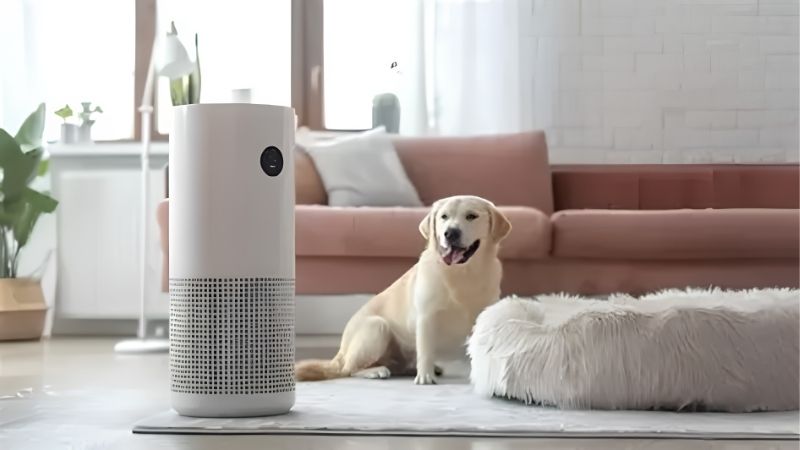
Carbon Weight, Type and CADR: The Numbers That Decide It
Carbon quantity is the specification that matters and the one manufacturers hide. A thin fabric sheet dusted with carbon holds a few grams and saturates within weeks, while a pellet or granular bed measured in pounds holds capacity for months of continuous duty.
Carbon type matters almost as much. Loose granules and pellets present far more surface area than a bonded coating, and some manufacturers impregnate carbon with additives targeted at ammonia, which is the dominant compound in litter box odour.
Humidity and temperature also affect how carbon behaves, since adsorption is a physical process rather than a chemical one. Very humid rooms reduce effective capacity because water molecules compete for the same surface area, which shortens the useful interval further.
Clean air delivery rate still applies to the particle side. A rating near 240 cubic feet per minute produces roughly four to five air changes per hour in a 350 square foot room, which is the turnover rate that keeps dander under control alongside the odour work.
Space and Fit: Placement Near the Source
Odour control benefits enormously from placing the machine near the source rather than in the middle of the room. A unit beside a litter tray or a dog bed intercepts the plume before it disperses, which is more efficient than treating the whole volume afterwards.
Check intake geometry against that plan. Front-intake designs need clear floor space ahead of them, while 360-degree cylindrical units tolerate a tighter corner. Measure the footprint and allow several inches of clearance around any grille.
Pre-Filters, Hair and the Maintenance Load
Pet households clog pre-filters faster than any other environment, because hair mats across the mesh within weeks. A washable pre-filter is close to essential here, since replacing a disposable one monthly becomes an expensive habit.
Filter architecture affects that cost too. Machines where the HEPA and carbon stages replace independently let you renew the saturated layer alone, while sealed multi-layer cartridges force the whole assembly out as soon as the carbon stops working.
A blocked pre-filter reduces airflow through both the HEPA and carbon stages, which quietly halves the machine’s effectiveness. Vacuuming it every two to four weeks is the single most valuable maintenance action in a home with animals.
Seven Machines Ranked by Carbon Capacity
The best air purifier pet odors call for carries real carbon weight, so the list below is ordered by how much genuine odour capacity each machine holds. Every entry names a real drawback. Figures reflect manufacturer specifications and pooled long-term owner reports rather than testing conducted by this site.
1. Austin Air Pet Machine — The Heavy Carbon Option
Carries a very large bed of activated carbon and zeolite measured in pounds rather than grams, specifically blended for ammonia and animal odour. Nothing else in the consumer market approaches this capacity.
It is heavy, industrial in appearance and expensive, and the single filter cartridge is a large one-off replacement cost. Fan noise is noticeable at higher settings.
2. Winix 5500-2 — Deep Carbon for the Money
A thick carbon pellet layer alongside true HEPA and a washable pre-filter, at a price where most rivals fit a thin coated sheet. For odour per dollar it remains the value benchmark.
The front intake needs clear floor space, top fan speed is loud, and the PlasmaWave feature adds little though it can be switched off.
3. Alen BreatheSmart 45i — Pet-Specific Filter Option
Alen sells a filter variant weighted toward odour and volatile compounds, layered over true HEPA media, with coverage suited to a large living room and a responsive automatic sensor.
The specialised filter costs more than a standard replacement, and the unit is physically large. Premium pricing throughout.
4. Rabbit Air MinusA2 — Customisable and Wall Mounted
Six filtration stages including a customisable layer that can be specified for pet odour, plus wall mounting that frees floor space entirely in a room already crowded with beds and bowls.
Purchase and filter costs are both high, and wall mounting requires anchoring and a nearby outlet. Airflow is modest compared with high-throughput rivals.
5. Coway Airmega 400 — High Throughput, Moderate Carbon
Strong clean air delivery for a large open space with a reasonable carbon layer, which suits multi-pet households where dander volume matters as much as smell.
Carbon depth is moderate rather than deep, so persistent litter odour may outlast the filter. The unit is large and filters are proprietary.
6. Levoit Core P350 — Compact and Pet-Focused
A small machine with a filter formulated for pet odour, sized for a bedroom, a laundry room or wherever the litter tray actually lives. The 360-degree intake suits a corner placement.
Coverage is genuinely limited to small rooms, and the sealed three-layer cartridge means carbon saturation forces replacement of otherwise healthy HEPA media.
7. Blueair Blue Pure 211i Max — Quiet High Volume
Moves a large volume of air at low noise, which helps in an open-plan space where a smaller unit would need to run audibly. Odour handling is adequate rather than specialised.
The carbon layer is moderate, the footprint is wide, and proprietary filters sit above average in price.
| Model | Carbon depth | Pre-filter | Coverage | Best for |
|---|---|---|---|---|
| Austin Air Pet Machine | Very deep, pounds | Washable | Large room | Severe ammonia odour |
| Winix 5500-2 | Deep pellet | Washable | 360 sq ft (33 m2) | Value odour control |
| Alen BreatheSmart 45i | Pet filter option | Washable | Large room | Odour plus allergens |
| Rabbit Air MinusA2 | Customisable | Washable | Up to 815 sq ft (76 m2) | Wall mounting |
| Coway Airmega 400 | Moderate | Washable | Large open plan | Multi-pet dander |
| Levoit Core P350 | Pet formula | Integrated | Small room | Litter tray rooms |
| Blueair 211i Max | Moderate | Washable fabric | Large open plan | Quiet high volume |
Filter costs and availability change regularly, so verify both at the time of purchase.
Source Control, Saturation and Running Cost
No best air purifier pet odors machine outruns an ongoing source. Filtration handles what reaches the air, and pairing it with a few habits reduces the load enough that carbon lasts closer to its rated life.
Reducing Odour at Source
Litter trays are the dominant source in cat households, and scooping daily plus a full change on schedule does more than any machine. Ventilation in that room matters equally, since concentrated ammonia saturates carbon rapidly.
For dogs, bedding is the reservoir. Washing covers weekly and vacuuming upholstery removes the material that continues releasing odour between cleanings, which extends filter life measurably in a busy household.
How Carbon Saturates and What It Costs
Carbon exhausts silently. There is no indicator light for odour capacity, and a filter that still looks serviceable may have stopped adsorbing weeks earlier. Replace on schedule rather than waiting for smells to return.
In a pet home, expect intervals at the short end of the manufacturer range, often three to six months for combined filters. Price a full year of replacements before choosing a machine with proprietary cartridges, since consumables dominate lifetime cost.
Ozone Warnings and Buying Windows
Avoid any device marketed as an ozone generator or air steriliser producing ozone, since ozone is a lung irritant and health authorities advise against its use in occupied spaces. Ionisers producing trace ozone should be switchable off.
On timing, filtration demand rises through autumn as windows close and heating concentrates indoor air. Promotion clusters around Prime Big Deal Days in early October and Black Friday through Cyber Monday at the end of November, both ahead of the shut-in months.
Frequently Asked Questions
These are the questions readers ask most when choosing the best air purifier pet odors demand rather than a general household machine.
Will a purifier remove litter box smell completely?
The best air purifier pet odors control can achieve reduces it substantially with enough carbon and good placement, but it cannot outpace an unscooped tray. Treat the machine as the second line and daily scooping as the first.
Does an ioniser help with odour?
Marginally at best, and some produce trace ozone as a by-product. Mechanical adsorption onto carbon is the reliable mechanism, and any ioniser function should be one you can switch off.
How much carbon is enough?
More than a coated sheet. If the specification describes a carbon-treated fabric rather than a weight of pellets or granules, expect odour capacity measured in weeks rather than months in a pet household.
Should I run it constantly?
Yes, on a low or automatic setting. The best air purifier pet odors control depends on continuous running, because odour is generated continuously, and intermittent operation lets concentrations rebuild between cycles while saving very little energy on a modern unit.
See More:
- Best low price dash cam
- Projector screens at Best Buy
- Best buy projector screens
- Best projector for games
- Best projector for gaming
Final Thoughts on Odour Control
The best air purifier pet odors call for is the one carrying real carbon weight rather than the highest HEPA claim, placed near the source and paired with source control. Particle filtration and odour adsorption are separate jobs done by separate materials.
Check the carbon specification before the coverage figure, measure the room against the clean air delivery rating, and price a year of filters. Then scoop the tray daily, because no machine on this list can substitute for that.
Write Your Review
No reviews yet. Be the first to share your experience!