The moment you agree to play at a friend’s wedding, a coffee shop, or a church service, an acoustic guitar with no pickup becomes a problem. Miking an acoustic properly needs a quiet room, a stand and someone who knows what they are doing. A built-in pickup and a quarter-inch jack turn the same instrument into something you can plug into any PA in thirty seconds. That is the entire argument for acoustic-electrics, and it is a strong one.
What you should not expect is that the pickup improves the guitar. Under-saddle piezo systems, which is what almost everything in this price bracket uses, capture string vibration through the saddle rather than air moving in the body. They are feedback-resistant and reliable, and they have a slightly brittle, plucky character that engineers call quack. You manage it with EQ and by not scooping the mids. This guide covers cutaway dreadnoughts, carbon-fibre travel instruments and full starter sets, and it is written for players who need the guitar to work both unplugged in a bedroom and plugged into a mixer.
Our top picks




As an Amazon Associate we earn from qualifying purchases at no extra cost to you.
Quick Comparison
| Product | Best For | Standout Feature | Watch Out For |
|---|---|---|---|
| Fender Redondo CE | Small-venue performers | Comfortable cutaway body with onboard tuner | Slim body gives up some unplugged low end |
| Best Choice Set (Natural) | First plug-in-capable guitar | All-wood cutaway with a full accessory set | Basic preamp with limited tone shaping |
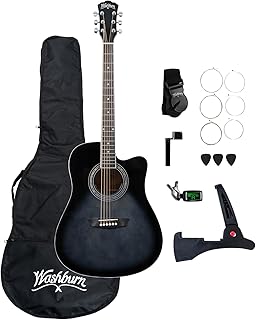
| Washburn WA90CE | Players wanting a warmer voice | Cutaway body with starter kit included | Factory action often needs lowering |
| Best Choice Set (Black) | Buyers who want the same kit in black | Identical spec with a gloss black finish | Dark finishes show fingerprints and scratches |
| Enya NOVA GO SP1 | Travel and humid climates | Carbon fibre body with onboard effects and Bluetooth | 35-inch scale feels small to full-size players |
| Fender FA-25CE | Stage-ready dreadnought tone | Onboard volume and tone with a built-in tuner | Full dreadnought depth is bulky when seated |
How to Choose
- Cutaway or not: A cutaway costs a small amount of unplugged bass and buys you real access above the twelfth fret. If you play melodies or solo arrangements, take the cutaway.
- Preamp features that matter: An onboard tuner and a volume control are essential on stage. Bass and treble sliders help you fight a boomy room; a phase switch helps you fight feedback.
- Body wood versus composite: Wood tops open up over time and sound richer acoustically. Carbon fibre ignores humidity and temperature entirely, which matters if the guitar lives in a car.
- Scale length and comfort: Shorter scales are easier to bar and travel better; standard scales give more tension and volume. Play seated for ten minutes before deciding based on specs.
- Plan your amplification: Piezo pickups sound harsh through guitar amps. A PA, an acoustic amp or a DI into a mixer is the right destination for these instruments.
Top Picks Reviewed
Best for Live Use: Fender Redondo CE
The California Series body shape is noticeably more comfortable seated than a traditional dreadnought, and the onboard tuner means you can check pitch between songs without unplugging or reaching for a clip-on. The cutaway keeps the upper register available for melody lines.
The slimmer body trades away a little unplugged authority. Strummed hard in a living room it does not thump the way a deep dreadnought does, though through a PA that difference largely disappears.
Best First Acoustic-Electric: Best Choice Starter Set
An all-wood 41-inch cutaway with a pickup fitted and a gig bag, strap and picks included. For someone who has never plugged a guitar into anything, having the whole chain arrive at once removes the guesswork.
The preamp is simple, offering little more than level control. That is workable when a sound engineer has a channel strip, and limiting when you are running your own mixer.
Warmest Voice: Washburn WA90CE
The tobacco burst WA90CE leans warmer and rounder than the brighter Fenders, which flatters fingerstyle and singer-songwriter material. The cutaway and included starter accessories make it a complete package.
Action out of the box is typically higher than ideal. A saddle adjustment brings the string height down and makes the guitar considerably easier to bar, and it is worth doing before you judge the instrument.
Best Alternative Finish: Best Choice Set in Black
Mechanically the same cutaway acoustic-electric package in a gloss black finish, which photographs well on stage and suits players who want the guitar to look less traditional.
Gloss black shows every fingerprint, buckle mark and pick scratch. Keep the supplied cloth in the bag and accept that it will not stay pristine.
Best Travel Instrument: Enya NOVA GO SP1
A 35-inch carbon fibre body ignores the humidity swings that crack and warp wooden tops, which makes it the sensible choice for anyone touring, camping or living somewhere with brutal seasons. Onboard effects, USB recording and a Bluetooth speaker make it a self-contained practice rig.
Full-size players will notice the reduced scale immediately; the string tension is looser and the fret spacing tighter. It is a superb second guitar and a compromise as a only guitar.
Best Traditional Dreadnought: Fender FA-25CE
This is the straightforward option: a familiar dreadnought voice with a cutaway, a built-in tuner and onboard volume and tone controls that let you tame a bright room from the guitar itself.
Dreadnought depth is real. Seated for a long set it presses into your ribs and forces a wide reach, which is why some players eventually move to shallower bodies.
Frequently Asked Questions
Can I plug an acoustic-electric into a regular guitar amp?
You can, but it will sound thin and harsh. Guitar amps are voiced for magnetic pickups. A PA system, an acoustic-specific amp or a DI box into a mixer gives you a much more natural result.
Why does my plugged-in acoustic sound quacky?
That is characteristic under-saddle piezo behaviour, exaggerated by an uneven saddle or too much treble. Cutting a little around the upper mids and making sure the saddle sits flat on the pickup usually fixes most of it.
How do I stop feedback on stage?
Turn down, move away from the monitors, and cut low mids where the body resonance sits. A soundhole cover is the traditional cure and works remarkably well at higher volumes.
Does the battery need changing often?
Onboard preamps draw very little, so a battery can last many months. The safe habit is to unplug the cable when you finish, because leaving it in keeps the preamp powered and drains the battery quietly.
Final Thoughts
Pick the body that is comfortable for the way you actually sit and play, then check that the preamp gives you a tuner and enough control to survive an unfamiliar room. A cutaway acoustic-electric with a modest pickup and a good setup will get you through open mics, services and small rooms without ever needing a microphone stand.