
Best mattress in Amazon searches return hundreds of boxed beds that look identical in photos. The specifications that separate them are firmness, profile height, whether there is a coil unit inside, and the trial period. This guide compares six on exactly those terms.
As an Amazon Associate we earn from qualifying purchases.
Our top picks


As an Amazon Associate we earn from qualifying purchases at no extra cost to you.
By Daniel Foster
Details here come from manufacturer documentation and from recurring themes in long-term owner feedback rather than from testing in a laboratory. Nothing here is medical advice; for persistent back or joint pain, speak with a physician or physical therapist.
🛒 Best Price Today on Amazon
Prime members get fast, free shipping on everything above, plus member-only deals. New members get a 30-day free trial — cancel anytime.
Start 30-Day Prime Free Trial →See Today’s Amazon DealsHow to Read a Boxed Mattress Listing
Listings bury the useful numbers under adjectives, which is why the best mattress in Amazon results is rarely the one with the longest description. Four specifications tell you how a bed will feel and how long it will last.
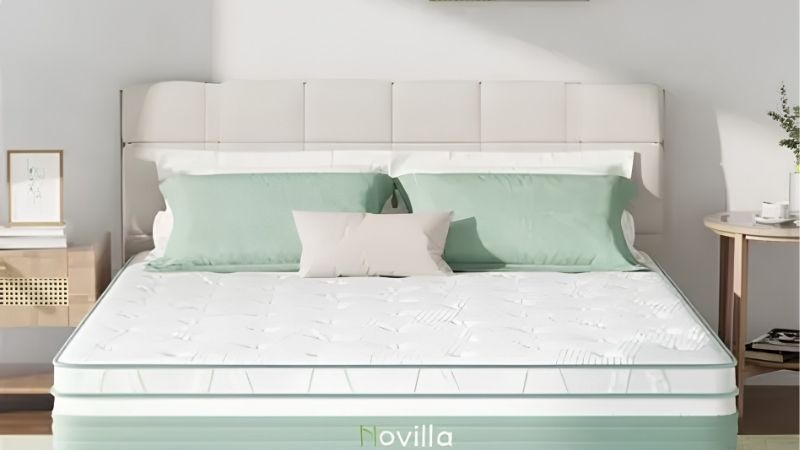
Firmness, Sleep Position and Support Capacity
Firmness on the industry scale of 1 to 10 is the decisive number for judging the best mattress in Amazon listings, and it has to be matched to sleeping position and body weight. Side sleepers generally sit well around 4 to 6, back sleepers around 5 to 7, and stomach sleepers around 6 to 8 where the hips need to stay level.
Body weight shifts all of that. Heavier sleepers compress foam further and typically experience any given mattress as softer than the label suggests, which is why hybrids with a steel coil unit and reinforced edges are the safer choice above roughly 230 lb (105 kg). Check the manufacturer’s stated support capacity rather than assuming.
Profile Height, Layers and Foam Density
Profile is the total thickness, typically 8 to 14 in (20 to 36 cm). Thinner beds cost less and suit guest rooms and bunks; 10 to 12 in (25 to 30 cm) is the mainstream range for a primary bed and gives room for a comfort layer over a support core.
Foam density, measured in lb per cubic foot, predicts durability better than thickness does. Denser foam resists permanent body impressions for longer. Look for CertiPUR-US certification, which addresses foam content and emissions, and expect some off-gassing odour for the first few days after unboxing.
Bed Size, Bedroom Space and Where It Fits
US standard sizes are Twin 38 x 75 in (96 x 191 cm), Twin XL 38 x 80 in, Full 54 x 75 in (137 x 191 cm), Queen 60 x 80 in (152 x 203 cm), King 76 x 80 in (193 x 203 cm) and California King 72 x 84 in (183 x 213 cm).
Measure the bedroom, not just the frame, and leave a walking path of at least 24 in (60 cm) on the sides you use. Also measure the doorway, stair turn and any tight hallway, because a compressed box is manageable but an expanded queen mattress is not.
Trial Period, Warranty and Return Logistics
A trial period is the only reliable way to judge a mattress, since 20 minutes in a showroom tells you very little. Trials on boxed beds range from 100 nights to a full year, and most require you to keep the bed at least a few weeks before initiating a return.
Read how returns are handled. Some brands arrange collection or donation; others expect you to manage disposal yourself, which is a significant practical difference for an item this size. Warranties of 10 years are standard and usually cover sagging beyond a stated depth rather than general comfort.
Six Boxed Mattresses Compared
No single best mattress in Amazon listings suits every sleeper, so these span budget foam, budget hybrid, mid-range foam and premium foam. Each entry lists a genuine drawback.
| Model | Type | Profile | Suits |
|---|---|---|---|
| Zinus Green Tea Memory Foam | All foam | 10 or 12 in / 25 or 30 cm | Budget, lighter sleepers |
| Lucid Hybrid | Foam over coils | 12 in / 30 cm | Budget with coil support |
| Tuft and Needle Original | Adaptive foam | 10 in / 25 cm | Balanced, sleeps cooler |
| Nectar Memory Foam | All foam | 12 in / 30 cm | Long trial, contouring |
| Linenspa Hybrid | Foam over coils | 8 or 10 in / 20 or 25 cm | Guest rooms, bunks |
| Ashley Chime Hybrid | Foam over coils | 12 in / 30 cm | Medium-firm hybrid feel |
Zinus Green Tea Memory Foam: The Volume Seller
Zinus built the boxed foam category on Amazon with this line, offered in 8, 10 and 12 in (20, 25 and 30 cm) profiles with CertiPUR-US certified foam and a 10-year limited warranty. The 12 in version reads medium in most owner reports, which suits side and back sleepers of average build.
All-foam construction is the limitation. Edge support is minimal, so sitting on the perimeter compresses it noticeably, and heavier sleepers report faster development of body impressions than on a hybrid. Expect a distinct new-foam odour for several days after unboxing.
Lucid Hybrid: Coils at a Budget Price
The Lucid 12 in (30 cm) hybrid places a foam comfort layer over individually wrapped coils, which improves airflow and edge stability compared with all-foam at similar money. Foam is CertiPUR-US certified and the warranty runs 10 years.
The comfort layer is thin relative to premium hybrids, so the coil support is felt more directly, which some sleepers read as firm and others as unrefined. Motion isolation is also weaker than a thick memory foam bed, worth weighing if a partner moves frequently at night.
Tuft and Needle Original: Foam That Does Not Sleep Hot
The Original uses a proprietary adaptive foam rather than traditional memory foam, at a 10 in (25 cm) profile, and it responds faster to movement than viscoelastic foam does. Owners consistently place it around medium-firm, which makes it one of the more position-neutral choices here.
Cooling is a genuine strength relative to dense memory foam, but the trade-off is contouring: sleepers who want the deep hug of memory foam usually find it too responsive. At 10 in it also feels shallow to anyone accustomed to a thick pillow-top.
Nectar Memory Foam: The Long Trial
Nectar’s 12 in (30 cm) memory foam bed pairs contouring comfort layers with a supportive base and is sold with a 365-night trial and a lifetime warranty, which is the longest trial window in this group by a wide margin. Motion isolation is strong, a genuine advantage for couples.
It is memory foam, so it sleeps warmer than the responsive-foam and hybrid options here despite cooling covers, and it takes longer to release when you change position. It also sits at the top of this price group, though it remains mid-range against the wider market.
Linenspa Hybrid: The Guest Room Answer
Available in 8 and 10 in (20 and 25 cm) profiles, this thin hybrid puts memory foam over a coil unit at the lowest price on this list. For a bunk bed, a guest room used a dozen nights a year or a first apartment, it is a sensible amount of money to spend.
It is not a primary bed for an adult sleeping on it nightly. The comfort layer is thin, edge support is limited, and owner reports of impressions developing within a couple of years are common for heavier sleepers. Judge it against its intended use.
Ashley Chime Hybrid: Familiar Medium-Firm Feel
The Chime hybrid at 12 in (30 cm) uses gel memory foam over a pocketed coil unit and lands in the medium-firm range most owners describe as conventional. For someone replacing an old innerspring who does not want the sinking sensation of foam, that familiarity is the appeal.
The cover and quilting are basic for the price, and the bed is heavy to manoeuvre alone during setup. Some owners also report the initial firmness softening over the first months more than the marketing suggests, so use the trial window deliberately.
Delivery, Break-In and Long-Term Ownership
Even the best mattress in Amazon search results behaves differently from a showroom purchase, in three specific ways that catch first-time buyers out.
Unboxing, Expansion and Off-Gassing
Compressed mattresses expand over 24 to 72 hours, and most feel firmer than their final state during the first week. Foam beds release a manufacturing odour during that period, which fades faster in a ventilated room and is one reason to unbox in the morning rather than at bedtime.
Do not judge firmness on night one. Bodies adapt to a new support surface over roughly two to four weeks, which is precisely why trial periods start where they do. If discomfort persists past that window, the trial exists for a reason.
Sagging, Impressions and What Warranties Cover
The characteristic failure is a permanent body impression where foam has lost resilience. Warranty terms usually specify a minimum depth, often around 1 to 1.5 in (2.5 to 4 cm), measured with no weight on the bed, before a claim qualifies.
Foundation requirements matter here. Most warranties require a slatted base with gaps under a stated width or a solid platform, and using an unsupported frame voids coverage. Photograph the label and keep the order record, since claims require proof of purchase years later.
Timing a Mattress Purchase
Mattresses follow the federal holiday calendar rather than the electronics discount cycle. Presidents Day in February, Memorial Day at the end of May and Labor Day in early September are the recurring promotional periods, with Labor Day the nearest one as summer ends.
That timing is worth knowing if your current bed is merely tired rather than urgent, since these are among the few points in the year when large, heavy goods are discounted meaningfully. No promotion is worth buying the wrong firmness for, and prices vary constantly regardless.
Frequently Asked Questions
Three questions come up in nearly every message from readers hunting for the best mattress in Amazon listings.
How long should a boxed mattress last?
Seven to ten years is the usual expectation for a mid-range bed used nightly, and budget all-foam models often show impressions sooner. Higher foam density and a coil support unit both extend that timeline, particularly for heavier sleepers.
Do I need a box spring?
Not usually. Most boxed mattresses are designed for a platform frame or slats spaced under about 3 in (7.5 cm) apart. Check the warranty terms, because using the wrong foundation is one of the most common reasons a claim is refused.
Can I flip it?
Almost all modern boxed beds are single-sided and should be rotated head to foot rather than flipped, typically every three to six months. Flipping a single-sided mattress puts the support core against your body and defeats the layered design entirely.
See More:
- Best low price dash cam
- Projector screens at Best Buy
- Best buy projector screens
- Best projector for games
- Best projector for gaming
Final Thoughts on Buying a Mattress Online
The best mattress in Amazon listings for you is the one whose firmness matches your sleeping position and body weight, sits at a profile your frame suits, and comes with a trial long enough to judge it properly. Measure the room and the doorway before ordering.
Side sleepers of average build have the widest choice; heavier sleepers should prioritise a hybrid with a coil unit and check the stated support capacity. Whichever best mattress in Amazon search results you settle on, note the trial deadline in your calendar the day it arrives, because that window is the only real protection you have.

Write Your Review
No reviews yet. Be the first to share your experience!