
Best rated air purifier for dust shopping should start with two specifications that rarely appear in headline marketing: the dust CADR figure specifically, and whether the machine has a washable pre-filter. Dust loads a purifier faster than any other particle type.
As an Amazon Associate we earn from qualifying purchases.
Our top picks
 LEVOIT Air Purifier for Home Allergies and
- Power Source: Corded Electric
- Control Method: Touch
- Filter Type: 3 in 1 Filtration
Covers up to 1073 square feet on one unit
Operates as quiet as 24 decibels in sleep mode
Captures 99.97 percent of particles down to 0.1 microns
Requires genuine Levoit replacement filters for proper performance
Corded electric design needs a nearby wall outlet
 LEVOIT Smart Air Purifier for Home Large
AHAM-verified performance covers rooms up to 1875 square feet
U-shaped inlet pulls in pet hair and odors efficiently
Designed specifically to filter allergens like pollen and dander
Stands nearly 20 inches tall, needing dedicated floor space
Listing does not specify the exact CADR number


As an Amazon Associate we earn from qualifying purchases at no extra cost to you.
By Daniel Foster
Specifications come from manufacturer documentation and long-term owner feedback rather than lab testing. Nothing here is medical advice; for persistent respiratory symptoms, speak with a physician.
🛒 Best Price Today on Amazon
Prime members get fast, free shipping on everything above, plus member-only deals. New members get a 30-day free trial — cancel anytime.
Start 30-Day Prime Free Trial →See Today’s Amazon DealsWhy Dust Is a Different Problem From Smoke or Pollen
Dust is a mixture of skin cells, textile fibres, soil particles and mite debris, and it is heavier and larger than smoke particles. A best rated air purifier for dust therefore needs different strengths from one bought for wildfire smoke. Four specifications determine whether a machine handles it well over years rather than weeks.
Dust CADR, Coverage and Air Changes
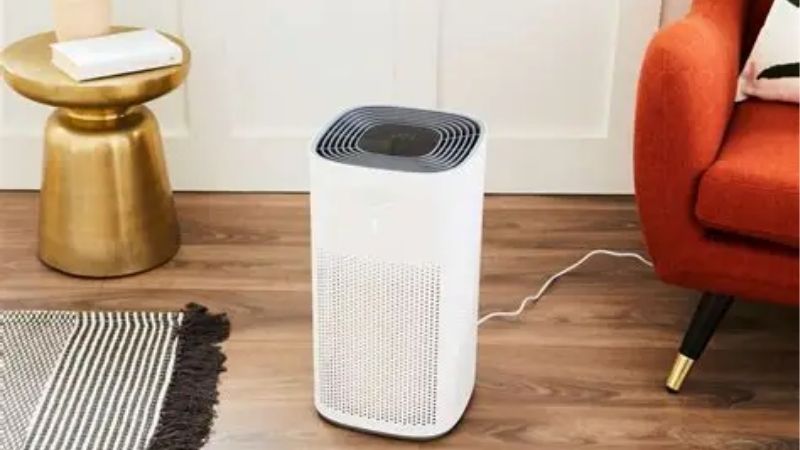
CADR is published separately for smoke, dust and pollen, and for any best rated air purifier for dust the dust figure is the only one worth reading. Checked against your room area, it is the decisive number: coverage claims are usually quoted at one air change per hour, while four to five changes is the useful standard.
Divide any headline coverage figure by four or five for an honest area. A living room of 400 sq ft (37 m2) points at a machine with dust CADR around 250 cfm or higher, which rules out most compact bedroom units regardless of how they are marketed.
Pre-Filters, Sealing and Filter Life
The pre-filter is the part that decides running cost. A washable one captures hair, lint and coarse dust before it reaches the HEPA media, which is what extends filter life from months to a year. Without one, the expensive filter clogs first and running costs climb sharply in a dusty home.
Sealing matters equally. If the housing lets air slip around the filter rather than through it, rated performance never reaches the room. Look for machines described as sealed systems, and be sceptical of loose-fitting third-party filters, which are the most common cause of bypass.
Placement, Clearance and Floor Space
Purifiers need 12 in (30 cm) or more of clearance to draw and discharge air, and units with a 360-degree intake need it on every side. Dust settles, so a machine on the floor intercepts more of it than one on a shelf, provided the intake is not against a skirting board.
Measure the clear floor area before choosing a size, since large machines need a committed position rather than being moved weekly. Positioning near the room’s main doorway usually catches more circulating dust than a corner behind furniture.
Noise and How Long It Runs
Dust control depends on running hours, not bursts. A machine you leave on a low setting all day removes far more than one run at maximum for an hour, so the noise figure at low speed decides how the machine actually gets used.
Sleep modes on good units sit around 24 to 28 dB; mid speeds reach 40 to 50 dB. Sizing up so the unit rarely needs its top speed is the standard approach, and it also reduces the frequency of filter changes.
Six Machines for Dusty Rooms
Every best rated air purifier for dust below was picked for its dust CADR, pre-filter design and filter economics rather than headline features or app polish. Each entry lists a genuine drawback, because filter costs over five years matter more than the purchase price.
| Model | Scale | Pre-filter | Best for |
|---|---|---|---|
| Levoit Core 600S | Large rooms | Integrated | High throughput per pound |
| Alen BreatheSmart 75i | Very large rooms | Washable | Whole floor coverage |
| Honeywell HPA200 | Mid to large rooms | Washable | Simple, widely stocked filters |
| Winix HR1000 | Mid to large rooms | Washable, pet focused | Hair and fibre loads |
| Shark Air Purifier MAX | Large rooms | Sealed system | Odour plus dust |
| Dyson Purifier Cool TP07 | Mid-size rooms | Sealed, no washable layer | Fan and filter in one |
Levoit Core 600S: Throughput at a Sensible Price
High airflow suited to rooms around 600 sq ft (56 m2) at a moderate air change rate, with a three-stage filter and app scheduling. For a large living room that collects dust from carpets and soft furnishings, it moves enough air to keep up without a premium price.
The 360-degree intake demands clearance on all sides, which is awkward in a furnished room. The pre-filter is integrated into the main filter rather than separately washable, so heavy hair and lint loads shorten filter life rather than being caught cheaply.
Alen BreatheSmart 75i: Whole-Floor Coverage
Covers very large open-plan areas with a washable pre-filter and a choice of filter types at purchase, so you can weight it toward allergens and dust specifically. The large filter area means longer intervals between replacements in a dusty home.
It is expensive to buy and its filters are expensive to replace, though the interval is long. It is also physically large, so it needs a genuine floor position rather than sliding between furniture.
Honeywell HPA200: Straightforward and Widely Supported
True HEPA media with a washable pre-filter, a strong dust CADR figure for the money and filters stocked almost everywhere, which keeps ownership simple over years. There are no app dependencies to age.
It is loud at higher settings, closer to a fan than the quieter premium designs, so it works best sized up and run low. The pre-filter needs replacing periodically as well as washing, which adds a small recurring cost.
Winix HR1000: Built for Hair and Fibres
Designed around pet hair and textile fibre loads, with a washable pre-filter that captures the coarse material dust-heavy homes generate. True HEPA plus a carbon layer handles the finer particles and associated odours.
PlasmaWave is an ionising function and can be switched off if you prefer to avoid it; the unit still works as a plain HEPA and carbon machine. Auto mode ramps audibly, and the pre-filter needs washing more often than owners expect in a dusty room.
Shark Air Purifier MAX: Sealed System and Odour Control
A sealed housing with HEPA and carbon layers, aimed at capturing fine dust without bypass, with a clean odour-neutralising mode for rooms that combine dust with cooking or pet smells. Coverage suits large rooms.
Filters are proprietary and their cost over a year should be checked before purchase. There is no separately washable pre-filter layer, so heavy hair loads reach the main filter and shorten its life.
Dyson Purifier Cool TP07: Fan First, Purifier Second
A sealed filtration system combined with a bladeless fan, with detailed air quality reporting in the app. In a room where you want cooling airflow and filtration from one appliance, it is the most elegant solution available.
It is expensive relative to its CADR, so on filtration per pound it loses clearly to conventional machines. There is no washable pre-filter, and replacement filters are costly, which stings in a dusty home where they load quickly.
Reducing Dust Before Filtering It
A best rated air purifier for dust is the last step in dust control rather than the first, and treating it as the whole answer guarantees disappointment. Three habits do more than the machine does.
Sources: Textiles, Carpets and Bedding
Most household dust originates indoors, from skin, textile fibres and soft furnishings. Washing bedding weekly at a warm temperature, vacuuming carpets with a sealed HEPA vacuum and reducing clutter that collects dust all cut the load at source.
A purifier reduces what stays airborne; it does nothing about what has already settled. The two work together, and a household relying only on the machine will keep seeing dust on surfaces and wondering why.
Filter Schedules in Dusty Homes
Dust loads filters faster than pollen or smoke, so intervals shorten in practice. Washable pre-filters should be rinsed monthly in a dusty home, and reduced airflow rather than a calendar date is the real signal that the main filter is due.
Price a year of filters before buying and check availability. Third-party filters vary in seal quality, and a filter that does not seat properly lets air bypass the media entirely, which defeats the sealed housing you paid for.
Seasonal Timing
Indoor dust concentrations rise once windows close and heating starts, which is also when demand for purifiers climbs. That period overlaps the Amazon deal event in early October and the Black Friday to Cyber Monday window in late November.
Buying spare filters during those windows is usually more valuable than upgrading the machine itself. Prices move constantly, so verify at the point of purchase rather than assuming any expected discount will appear.
Frequently Asked Questions
Three questions come up in nearly every message from readers shortlisting a best rated air purifier for dust.
Will a purifier stop me dusting?
No, but it reduces how quickly surfaces need it. Larger particles settle before a machine can capture them, so cleaning and filtration are complementary. Expect less frequent dusting rather than none.
Do I need HEPA or is a cheaper filter fine?
True HEPA capturing 99.97 percent at 0.3 microns is the standard worth insisting on, because fine dust and mite debris sit well below what coarse filters catch. A washable pre-filter in front of it is what keeps the HEPA layer affordable.
Does an ioniser help with dust?
It can make particles clump and settle faster onto surfaces, which is not the same as removing them, and some designs produce ozone as a by-product. A sealed HEPA machine with adequate CADR is the more reliable answer.
See More:
- Best low price dash cam
- Projector screens at Best Buy
- Best buy projector screens
- Best projector for games
- Best projector for gaming
Final Thoughts on Controlling Household Dust
The best rated air purifier for dust is the one with a strong dust CADR for your room area, a washable pre-filter to protect the expensive media, and a sealed housing so air cannot bypass the filter. Those three beat any feature list.
Measure the room and the clear floor space before ordering, and price a year of filters as part of the decision. Whichever best rated air purifier for dust you choose, run it continuously on a low setting and keep vacuuming, because the machine handles what is airborne and nothing else.





Write Your Review
No reviews yet. Be the first to share your experience!