
Best single serving coffee maker choices are decided by three things a listing photo hides: how wide the machine really is, whether a travel mug fits under the spout, and whether you are committing to pods or free to use your own grounds.
As an Amazon Associate we earn from qualifying purchases.
Our top picks


As an Amazon Associate we earn from qualifying purchases at no extra cost to you.
By Daniel Foster
Specifications come from manufacturer documentation and long-term owner feedback rather than lab testing. Prices move constantly, so machines are described as budget, mid-range or premium rather than by figures.
🛒 Best Price Today on Amazon
Prime members get fast, free shipping on everything above, plus member-only deals. New members get a 30-day free trial — cancel anytime.
Start 30-Day Prime Free Trial →See Today’s Amazon DealsWhat Actually Matters in a One-Cup Machine
A best single serving coffee maker is bought for constrained spaces and rushed mornings, which changes the priorities entirely. Capacity stops mattering and clearance, format and running cost take over. Four specifications decide whether one fits your situation.
Brew Format, Cup Size and Footprint
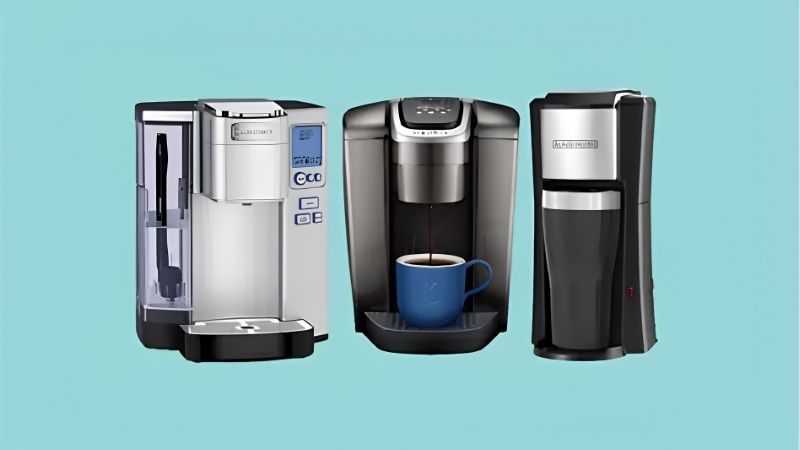
These are the decisive numbers behind any best single serving coffee maker comparison. Format means pod, ground coffee or both; cup size typically spans 6 to 14 oz (175 to 415 mL); footprint on the smallest machines drops to around 5 in (13 cm) wide, which is the reason many of them get bought at all.
Reservoir capacity splits this category cleanly. Machines with no tank are filled per cup, which is fine for one drink a day and tiresome for three. Machines with a 40 oz (1.2 L) tank cost more counter space in exchange for three or four cups between refills.
Travel Mug Clearance and Where It Fits
Clearance under the spout is the specification that catches people out more than any other, because listings rarely state it. A typical travel tumbler is 7 to 8 in (18 to 20 cm) tall, and many machines only accommodate that after removing the drip tray, if at all.
Measure your usual mug, the counter width and the height to the shelf above before ordering. On a desk, also consider where the spent grounds or pods go, because a machine with no bin means walking to a kitchen after every cup.
Pods, Grounds and the Cost Per Cup
Running cost is where the formats separate most sharply over a year. Pods are convenient and expensive: a daily habit runs to several hundred pods a year, and buying them singly rather than in bulk roughly doubles the cost. Machines that brew ground coffee natively, or accept a reusable basket, remove that constraint entirely.
Manual brewers change the arithmetic further, since they have no electronics to fail and no consumables beyond filters. For an office desk with a kettle nearby, that is often the most practical answer rather than the most obvious one.
Brew Temperature and Speed
The Specialty Coffee Association recommends brew water between 195 and 205 degrees F (90 to 96 C). Compact machines with no internal heated tank heat water per cup, which takes longer and often runs at the low end of that range, producing a thinner cup.
Machines with a heated reservoir pour in under a minute but keep water hot continuously, which uses more power and encourages scale. For a single cup a day the difference is small; for a shared office machine it matters.
Six One-Cup Machines Compared
These cover pod machines, ground coffee machines and one manual brewer, so the comparison reflects everything a best single serving coffee maker can actually mean rather than only the pod aisle. Each entry lists a genuine drawback, since those decide between machines with similar claims.
| Model | Format | Reservoir | Best for |
|---|---|---|---|
| Hamilton Beach The Scoop | Ground coffee | Fill per cup | Avoiding pods entirely |
| Keurig K-Mini Plus | Pods | Single cup, removable | Narrowest footprint |
| Black and Decker CM618 | Ground coffee | Fill per cup | Lowest outlay |
| Instant Solo | Pods and grounds | Around 40 oz / 1.2 L | Flexibility |
| Nespresso Vertuo Pop | Capsules | Around 18 oz / 560 mL | Crema-style coffee |
| AeroPress Original | Manual | None | Desks, travel, no power |
Hamilton Beach The Scoop: Ground Coffee, One Cup at a Time
Brews directly from ground coffee using a scoop-shaped mesh filter, with brew sizes from a small cup to a 14 oz (415 mL) travel mug and enough clearance to use one. For anyone who wants single-serve convenience without pod costs, this is the most direct answer here.
You fill it with water each time, and the mesh basket lets a little sediment through compared with paper. Brew temperature is not held in the ideal range as consistently as certified machines, so the cup is good rather than exceptional.
Keurig K-Mini Plus: Under Five Inches Wide
At roughly 4.5 in (11.5 cm) wide with a removable reservoir sized for one cup, a strong-brew setting and pod storage in the base, this is the machine that fits where nothing else does. Brew sizes span 6 to 12 oz (175 to 355 mL).
There is no multi-cup tank, so every drink involves filling and a fresh heat cycle. Pod costs also apply, though it accepts a reusable basket sold separately, which is worth buying at the same time if running cost matters.
Black and Decker CM618: The Budget Ground Coffee Option
A basic single-cup brewer with a permanent filter and an included 16 oz (475 mL) mug, at the lowest price in this group. It suits a dorm room, a first flat or an office desk where expectations are modest and cost matters most.
Build quality is light and the brew runs cooler than the recommended range, so the cup is functional rather than good. There is no auto shut-off timer and no adjustment of brew strength beyond changing the dose.
Instant Solo: Pods or Grounds, With a Tank
Brews from pods or ground coffee using an included reusable basket, drawing from a roughly 40 oz (1.2 L) reservoir, with brew sizes from 6 to 12 oz (175 to 355 mL) and a bold setting. The tank is what separates it from most compact machines.
It is wider than the slim pod machines, so the flexibility costs counter space. The reusable basket also needs rinsing after every use, which removes some of the convenience that pushed you toward single-serve in the first place.
Nespresso Vertuo Pop: Capsules and Crema
Uses centrifugal extraction with barcoded capsules to produce a crema-topped cup across several sizes, in a compact body with a small reservoir. For someone who wants something closer to a cafe drink than filter coffee, it is the easiest route.
The capsule ecosystem is proprietary and more expensive than K-Cup style pods, with fewer third-party options because of the barcode system. The small tank also needs refilling frequently, and used capsules accumulate faster than expected.
AeroPress Original: No Power, No Pods
A manual press that brews a concentrated cup in about a minute using paper or metal filters, needing only hot water from a kettle. It is nearly unbreakable, packs into a bag and produces better coffee than most machines in this group.
It requires a kettle and about two minutes of attention including cleaning, so it is not a press-and-walk-away device. Yield is one cup at a time and the plunge takes a little strength, which is worth knowing for anyone with hand or wrist problems.
Living With a One-Cup Machine
Any best single serving coffee maker fails in predictable ways, and most of it comes down to water and neglect rather than component quality. Three ownership realities decide how long yours lasts.
Scale in Machines With Small Passages
Compact brewers have narrow water paths, so calcium reduces flow faster than in a large drip machine. Symptoms arrive as shorter pours, cooler coffee and a straining sound. Descaling every three to six months is the guidance, and quarterly is realistic in hard water areas.
Using filtered water slows scale considerably and costs almost nothing. In shared offices, where nobody owns the maintenance, a machine with a visible reminder light is far more likely to actually get descaled.
Baskets, Needles and Oil Residue
Pod machines clog at the entry or exit needle, which shows as overflow or a trickle; a straightened paperclip during cleaning prevents most of it. Ground coffee machines accumulate oils in the mesh basket, which turn rancid and produce a stale taste.
Wash reusable baskets properly rather than rinsing them, and let them dry before reassembly. On manual brewers, the same rule applies to metal filters, which need a real scrub rather than a rinse under the tap.
Buying Timing and Realistic Expectations
Small kitchen electrics track the electronics discount calendar, with the Amazon deal event in early October and the Black Friday to Cyber Monday window in late November drawing the most attention, since compact coffee machines sell heavily as gifts.
Expectations matter more than the discount. A compact single-serve machine is bought for speed and footprint, not for the best cup in the house, and no model at this size matches a certified drip brewer or a proper pour over for flavour.
Frequently Asked Questions
Three questions come up in nearly every message from readers choosing a best single serving coffee maker for a desk, a dorm or a small kitchen.
Can I avoid pods completely?
Yes. Several machines here brew ground coffee natively, most pod machines accept a reusable basket sold separately, and a manual press needs nothing but hot water. Pods are a convenience choice, not a requirement of the format.
Will my travel mug fit?
Only on machines that state the clearance or allow the drip tray to be removed. Measure your tumbler first, since a 7 in (18 cm) mug is taller than several compact machines can accommodate even with the tray out.
Are these machines slower than a kettle?
Machines with a heated tank pour in under a minute, faster than boiling a kettle. Machines that heat per cup take two to three minutes, which is roughly kettle speed, so the advantage is convenience rather than time.
See More:
- Best low price dash cam
- Projector screens at Best Buy
- Best buy projector screens
- Best projector for games
- Best projector for gaming
Final Thoughts on One-Cup Brewing
The best single serving coffee maker for a desk is not the same machine as the one for a dorm kitchen. Decide first whether you accept pod costs, then check the footprint and the clearance under the spout against a tape measure and your actual mug.
Ground coffee machines cost less to run, pod machines are faster and tidier, and a manual press beats both on cup quality if a kettle is nearby. Whichever best single serving coffee maker you choose, descale on schedule, since narrow water paths are what these machines die of.





Write Your Review
No reviews yet. Be the first to share your experience!