
Key takeaways
Coffee maker at Best Buy searches usually end in an aisle full of machines that brew in four completely different ways. Choosing the brew type before the brand is what prevents buying an espresso machine for someone who wanted a pot of drip coffee every morning.
As an Amazon Associate we earn from qualifying purchases.
Our top picks


As an Amazon Associate we earn from qualifying purchases at no extra cost to you. Ratings are shown as listed on Amazon.
By Daniel Foster
Specifications come from manufacturer documentation and long-term owner feedback rather than lab testing. Retailer stock and in-store pricing change constantly and are not quoted here; compare current figures wherever you buy.
🛒 Best Price Today on Amazon
Prime members get fast, free shipping on everything above, plus member-only deals. New members get a 30-day free trial — cancel anytime.
Start 30-Day Prime Free Trial →See Today’s Amazon DealsPick the Brew Type Before You Pick a Machine
Brew type is the first fork in the road. Every coffee maker at Best Buy, in another shop or in an online listing belongs to one of four families, and each one demands different things from you every morning. Four specifications sort them out.
Brew Type, Capacity and Counter Footprint
These three are the decisive numbers. Drip machines make 8 to 14 cups at roughly 5 oz (150 mL) each; pod machines make one cup of 6 to 12 oz (175 to 355 mL); grind-and-brew machines match drip capacity but add a burr or blade grinder; entry espresso machines pull 1 to 2 oz (30 to 60 mL) shots.
Footprint follows the format. A 12-cup drip machine typically needs 9 x 13 in (23 x 33 cm) and 14 in (36 cm) of height, grind-and-brew units are taller again, and espresso machines are deeper because of the portafilter clearance in front. Measure counter width, depth and the height to the cabinet above before ordering anything.
How Much Effort You Want Each Morning
Pod machines take about a minute with no cleanup beyond emptying a used pod. Drip machines take five minutes including filling and rinsing the basket. Grind-and-brew adds a grinder to clean weekly, and espresso adds dosing, tamping and rinsing the group head every single time.
Being honest about this is the difference between a machine that stays on the counter and one that migrates to a cupboard by spring. A capable machine that demands more than your routine allows produces worse coffee than a simple one used properly.
Running Costs Over a Year
Pods cost several times what ground coffee costs per cup, and proprietary flavours widen the gap further. Whole beans are cheapest per cup but need a grinder, which is why grind-and-brew machines can pay for themselves over a couple of years in a two-cup-a-day household.
Espresso adds a different cost: good shots need a decent burr grinder, and the machine is only as good as what feeds it. Budget for that from the start rather than discovering it after buying the machine.
Brew Temperature and What It Does to the Cup
The Specialty Coffee Association recommends brew water between 195 and 205 degrees F (90 to 96 C). Budget drip and pod machines often run below that, which under-extracts the grounds and produces the thin, sour result people blame on their beans rather than their machine.
Espresso works differently, using roughly 9 bar of pressure and a short contact time, so temperature stability matters more than peak heat. Machines with a thermoblock heat quickly but drift more than a machine with a larger boiler, which is the trade-off at the entry level.
Six Machines Across the Four Brew Types
Two drip options, one grind-and-brew, one hybrid, one small-batch specialist and two entry espresso choices below, which covers what any coffee maker at Best Buy shelf or online listing realistically offers. Each entry lists a genuine drawback.
| Model | Brew type | Capacity | Best for |
|---|---|---|---|
| Mr. Coffee 12-Cup Programmable | Drip | 12 cups | Lowest cost per cup |
| Zojirushi EC-DAC50 Zutto | Drip | 5 cups | Small households |
| Cuisinart Grind and Brew | Grind-and-brew | 10 to 12 cups | Whole beans, no extra grinder |
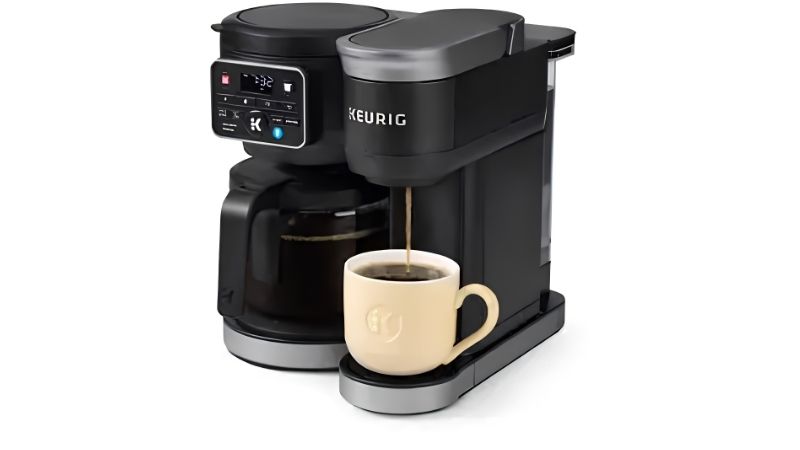
| Hamilton Beach 2-Way FlexBrew | Drip and single cup | Cup or carafe | Mixed households |
| De’Longhi Stilosa | Manual espresso | 1 to 2 shots | Learning espresso cheaply |
| Breville Bambino | Espresso | 1 to 2 shots | Fast, stable shots |
Mr. Coffee 12-Cup Programmable: The Baseline
A 12-cup glass carafe machine with delay start, a pause-and-serve feature and a permanent filter option, at the lowest price in this group. For a household that simply wants a pot of coffee at 7am without thinking about it, this does exactly that and nothing more.
Brew temperature is not held in the recommended range consistently, so the cup is noticeably flatter than a certified brewer using the same beans. The hot plate also continues cooking whatever remains in the carafe, which is why the second cup tastes worse than the first.
Zojirushi EC-DAC50 Zutto: Small, Simple, Well Made
A five-cup machine with a charcoal water filter, a compact footprint under 6 in (15 cm) wide and a reputation for lasting years without incident. In a small kitchen where a 12-cup machine is absurd, it is the sensible answer.
There is no programmable timer and no thermal carafe, so the small glass jug sits on a warmer. Capacity genuinely limits it to one or two drinkers, and the narrow spout pours more slowly than a wide carafe.
Cuisinart Grind and Brew: Whole Beans Without a Separate Grinder
Grinds beans immediately before brewing, which is the single biggest improvement available to drip coffee, and holds a full carafe for a household. Buying whole beans also cuts the cost per cup compared with pods or pre-ground tins.
The built-in grinder is a blade or basic burr rather than a quality standalone unit, so grind consistency is mediocre and it is noisy at 6am. It also needs weekly cleaning around the grinder chute, which is the step owners skip and then blame for stale-tasting coffee.
Hamilton Beach 2-Way FlexBrew: A Cup or a Pot
Brews a single cup from grounds or a pod on one side and a full carafe on the other, with separate brewing paths. In a household where one person wants a travel mug at six and another wants a pot at eight, that split is genuinely practical.
The single-serve side has no reservoir, so you fill it per cup, and the plastic construction feels light for the size. Two brewing systems also mean two cleaning routines rather than one.
De’Longhi Stilosa: The Cheapest Real Espresso
A manual 15 bar pump machine with a steam wand, which is the lowest-cost way to learn espresso properly rather than pressing a button. Everything is under your control, including dose, tamp and shot timing.
It comes with a pressurised basket that flatters poor grinding, and it heats slowly with noticeable temperature drift between shots. Without a decent burr grinder, results will disappoint regardless of technique, so budget for one.
Breville Bambino: Fast and Stable at the Entry Level
Heats in a few seconds using a thermojet system, delivers stable temperature and includes an automatic steam wand that handles milk texturing. For someone who wants cafe-style drinks on a weekday, it removes most of the waiting.
It is considerably more expensive than the Stilosa and still needs a proper grinder alongside it. The small footprint also means a small drip tray and water tank, both of which need attention more often than on larger machines.
Buying, Descaling and Making It Last
Whether you buy a coffee maker at Best Buy, another retailer or online, three ownership realities determine how long it keeps making decent coffee.
Scale and Water Quality
Calcium builds inside the heating element and narrows the water path, producing longer, weaker brews and cooler coffee. Descaling every three to six months is standard guidance across brew types, and quarterly is realistic in hard water. Espresso machines suffer fastest because their passages are narrower.
A charcoal filter in the reservoir improves taste but does nothing about minerals, so it does not replace descaling. Using filtered water slows the whole process and is the cheapest thing you can do to extend a machine’s life, whichever format you choose.
Oils, Baskets and Grinder Chutes
Coffee oils accumulate anywhere water and grounds meet, and they turn rancid, producing a stale note people blame on old beans. Baskets and carafes need washing daily, spray heads need a monthly clean, and grind-and-brew chutes need brushing out weekly.
Thermal carafes need particular attention because you cannot see inside them. A long-handled brush and a periodic soak keep them clean, while abrasive scourers scratch the interior and make residue cling faster afterwards.
Retail Versus Online, and When to Buy
Buying a coffee maker at Best Buy or another shop lets you judge the footprint in person and return a faulty unit over the counter, while online listings offer more models, replacement carafes and years of owner feedback. Warranty on this category is usually one year, so register the machine and keep proof of purchase either way.
Kitchen electrics follow the electronics discount calendar, with the Amazon deal event in early October and the Black Friday to Cyber Monday window at the end of November drawing the most attention, since coffee machines sell heavily as gifts. Prices move constantly, so verify at the moment of purchase.
Frequently Asked Questions
Three questions come up in nearly every message from readers comparing a coffee maker at Best Buy with online options.
Is grind-and-brew worth the extra money?
If you already buy whole beans, yes, because grinding immediately before brewing is the biggest single upgrade to drip coffee. If you buy pre-ground tins and have no intention of changing, you are paying for a grinder you will not use.
Can an espresso machine make regular coffee?
It makes a lungo, which is a longer shot, not a mug of drip coffee. Households that want both usually end up with two machines or a drip maker plus a separate milk frother, which is worth knowing before spending on espresso.
Are store and online models the same?
Retailers sometimes carry model numbers with different colours or accessory bundles, especially around promotions. The brewing hardware within a product line is generally identical, so compare capacity, carafe type and brew temperature rather than assuming a different suffix means different performance.
See More:
- Best low price dash cam
- Projector screens at Best Buy
- Best buy projector screens
- Best projector for games
- Best projector for gaming
Final Thoughts on Choosing a Format
Anyone comparing a coffee maker at Best Buy with the same model online is looking at identical hardware, so the real decision is the brew type. Match it to how much effort your mornings actually allow, then check capacity and footprint against a measured counter.
Drip suits households drinking several cups, pod suits one person in a hurry, grind-and-brew suits whole-bean drinkers, and espresso suits people who enjoy the process. Whichever coffee maker at Best Buy or online you choose, descale on schedule and wash the basket daily, because both matter more to the cup than the price.





Write Your Review
No reviews yet. Be the first to share your experience!