
Best rated whole house humidifier choices come down to three mechanisms mounted on your ductwork, and they behave very differently. Bypass units are cheapest and depend on the furnace running, fan-powered units add their own airflow, and steam units work independently of the heating entirely.
As an Amazon Associate we earn from qualifying purchases.
Our top picks




As an Amazon Associate we earn from qualifying purchases at no extra cost to you.
By Daniel Foster
Specifications come from manufacturer documentation and long-term owner feedback rather than lab testing. Installation of ducted equipment involves plumbing and electrical work; use a qualified heating contractor where required by local codes.
🛒 Best Price Today on Amazon
Prime members get fast, free shipping on everything above, plus member-only deals. New members get a 30-day free trial — cancel anytime.
Start 30-Day Prime Free Trial →See Today’s Amazon DealsThe Three Mechanisms and What Each Demands
All three raise humidity across a ducted home, so a best rated whole house humidifier shortlist should be built on mechanism first. What differs is output, running cost and how much of your heating system the unit depends on. Four specifications explain it.
Type, Output in Gallons Per Day and Coverage
These three are the decisive numbers for any best rated whole house humidifier. Bypass units typically deliver 12 to 17 gallons (45 to 64 L) per day; fan-powered units reach roughly 17 to 18 gallons (64 to 68 L) and add their own fan so they run without the furnace blower; steam units go higher and control humidity most precisely.
Coverage claims of 3,000 to 4,000 sq ft (280 to 370 m2) assume a reasonably sealed, insulated house. A draughty older property loses moisture faster, so match output to the building rather than to floor area alone.
Install Requirements and Where It Physically Goes
Installation demands differ sharply between the three. Bypass units need a duct connection on both the supply and return sides with a bypass duct between them, plus a water line and usually a drain. Fan-powered units skip the bypass duct, which is why they suit tight furnace closets where space is scarce.
Measure the clearance around your plenum and the run to the nearest water supply before choosing. Steam units additionally need a substantial dedicated electrical circuit, which is often the constraint that decides the question in an older house.
Water Use, Drainage and Drainless Options
Evaporative units run water across a panel and send the excess to a drain, so a proportion of the supply is discarded. In a house without a convenient floor drain, that requires a condensate pump, which is another component to maintain.
Drainless evaporative models exist and use all the water they draw, which suits homes where plumbing a drain is difficult. They typically need the water panel replaced more often, since minerals concentrate rather than washing away.
Controls, Humidistats and Outdoor Compensation
A basic humidistat holds a fixed setpoint, which is fine in mild weather and dangerous in hard frost. Controls with outdoor temperature compensation lower the target automatically as it gets colder, preventing condensation inside walls and on windows.
Automatic controls are the single feature most worth paying for on any ducted system, because the damage from running too humid in winter is expensive and invisible until it is not. Keep a hygrometer in a living space regardless of what the controller reports.
Six Ducted Systems Compared
Every best rated whole house humidifier below represents a different mechanism, spanning bypass, fan-powered, drainless and steam designs so they can be compared directly. Each entry lists a genuine drawback.
| Model | Mechanism | Output | Best for |
|---|---|---|---|
| Aprilaire 500 | Bypass | Around 12 gal / 45 L per day | Smaller homes |
| Aprilaire 700 | Fan powered | Around 18 gal / 68 L per day | Tight furnace closets |
| Aprilaire 400 | Drainless evaporative | Around 17 gal / 64 L per day | No drain available |
| Aprilaire 865 | Steam | High output | Boilers and heat pumps |
| Honeywell HE280 | Bypass | Around 12 gal / 45 L per day | Widely stocked parts |
| GeneralAire 1042 | Bypass | Around 17 gal / 64 L per day | Budget whole-house |
Aprilaire 500: The Entry Bypass
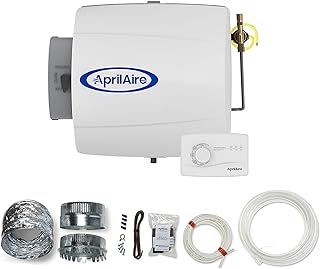
A compact bypass unit suited to smaller ducted homes, with a straightforward water panel and readily available parts. It is the least expensive route into ducted humidification and the simplest to service.
Output is the lowest here, so a large or draughty house will not reach target in cold weather. Like all bypass designs, it only adds moisture while the furnace blower is running, which limits it during mild spells.
Aprilaire 700: Fan Powered, No Bypass Duct
Includes its own fan, so it does not need a bypass duct and can run independently of the furnace blower. That combination gives both higher output and installation flexibility in cramped mechanical rooms.
It costs more than a bypass unit and uses slightly more electricity because of the fan. The fan is also an additional moving part, and it is audible in a utility room close to living space.
Aprilaire 400: When There Is No Drain
A drainless evaporative design that uses all the water it draws, removing the need for a floor drain or a condensate pump. For a basement or closet where plumbing a drain is genuinely awkward, that solves the main obstacle.
Because minerals are not flushed away, the water panel scales faster and needs replacing more often, particularly in hard water. Output also drops as the panel loads, so replacement discipline matters more than on drained units.
Aprilaire 865: Steam and Precise Control
Generates steam electrically and therefore works with boilers, heat pumps and any system where the furnace rarely runs. Humidity control is the most precise of any design here, and output is the highest.
It is expensive to buy and install, needs a dedicated high-capacity electrical circuit and consumes considerably more power than evaporative units. The steam canister also requires periodic descaling or replacement depending on water hardness.
Honeywell HE280: Parts Availability First
A widely installed bypass unit with pads and parts stocked almost everywhere, which is a genuine advantage when a component fails mid-winter. Installation follows the standard bypass pattern and most contractors know it well.
Output matches the entry bypass class rather than the fan-powered units, so it suits moderate homes. It also shares the fundamental bypass limitation of depending entirely on furnace runtime.
GeneralAire 1042: Budget Output
A bypass unit delivering output close to the larger Aprilaire models at a lower purchase price, making it the value choice when a contractor is already installing ductwork connections.
Build quality and the control interface are more basic than the premium brands, and parts are less widely stocked, which matters when something fails in January. Documentation is also thinner for a self-install.
Installation, Maintenance and Avoiding Damage
A best rated whole house humidifier is set-and-forget equipment right up until it causes a problem, and the problems are expensive. Three points prevent that.
Annual Water Panel Service
The evaporative panel scales and clogs over a season, reducing output steadily until the system appears to have failed. Replacing it annually before the heating season is the single maintenance task that keeps a unit performing.
Check the solenoid valve and drain line at the same time, since a partially blocked drain causes overflow, and a stuck valve leaves water running continuously. Both are cheap to inspect and expensive to ignore.
Setpoints, Condensation and Building Fabric
Running too humid in cold weather drives moisture into wall cavities and produces condensation on windows. The consequences appear as mould around frames first and inside the structure later, which is why outdoor temperature compensation matters.
Reduce the setpoint whenever windows fog persistently, and keep a hygrometer in a main living space. Aim for 30 to 50 percent relative humidity, trending toward the lower end as outdoor temperatures fall.
Contractors, Codes and Buying Timing
Cutting into ductwork and connecting a water supply falls under local codes in many areas, and steam units generally require an electrician. Getting the installation right matters more than which brand is on the box.
Heating equipment discounts follow the autumn calendar, with the Amazon deal event in early October and the Black Friday to Cyber Monday window in late November drawing the most attention. Buy water panels at the same time, since they sell out mid-season, and verify current pricing at purchase.
Frequently Asked Questions
Three questions come up in nearly every message from readers specifying a best rated whole house humidifier for a ducted home.
Bypass or fan powered?
Fan powered if space is tight or your furnace runs infrequently, since it supplies its own airflow and higher output. Bypass if you have room for the duct and want the simplest, cheapest installation with the fewest moving parts.
Do I need steam?
Only if your heating does not move warm air through ducts regularly, such as a boiler or heat pump system, or if you need precise control in a very dry climate. Otherwise the running cost is hard to justify.
Can I install one myself?
Some homeowners do fit bypass units, but it involves cutting ductwork, tapping a water line and wiring to the furnace control. Local codes may require a licensed contractor, and a mistake here leaks water onto a furnace, so check before starting.
See More:
- Best low price dash cam
- Projector screens at Best Buy
- Best buy projector screens
- Best projector for games
- Best projector for gaming
Final Thoughts on Ducted Humidification
A best rated whole house humidifier decision is really a mechanism decision: bypass for simplicity and cost, fan powered for output and tight spaces, steam for homes without forced air heating. Match it to how your heating actually behaves.
Measure the clearance around the plenum and the route to a water supply before ordering, and specify a control with outdoor temperature compensation. Whichever best rated whole house humidifier you install, replace the water panel annually and watch for window condensation, since those two habits protect both the unit and the house.





Write Your Review
No reviews yet. Be the first to share your experience!